
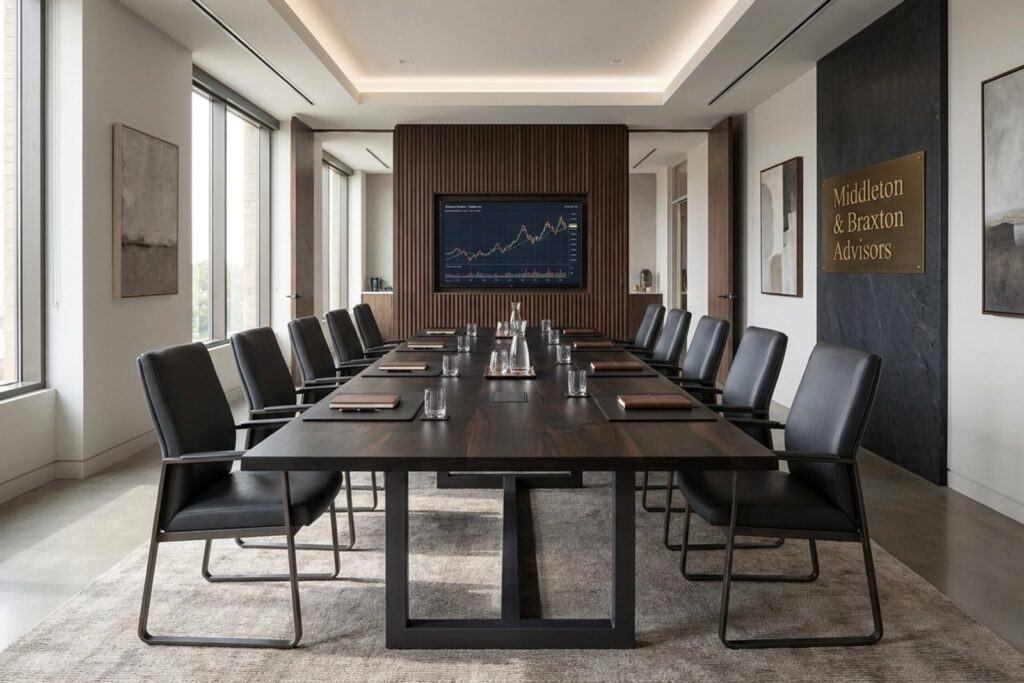
Custom conference tables from Fargo Woodworks are built to your length, width, species, finish and base, starting from rough lumber in our shop in Fargo, North Dakota. Lengths run from 7 to 20 feet, widths from 36 to 60 inches, and every top is 1.5 inches of solid hardwood. This page walks through what you actually choose, how the table gets made once you order it, and what shows up at your door.
If you are still working out size and shape, start with our conference table buyer’s guide. This page picks up after that, at the point where custom conference tables stop being a catalog item and become a build.
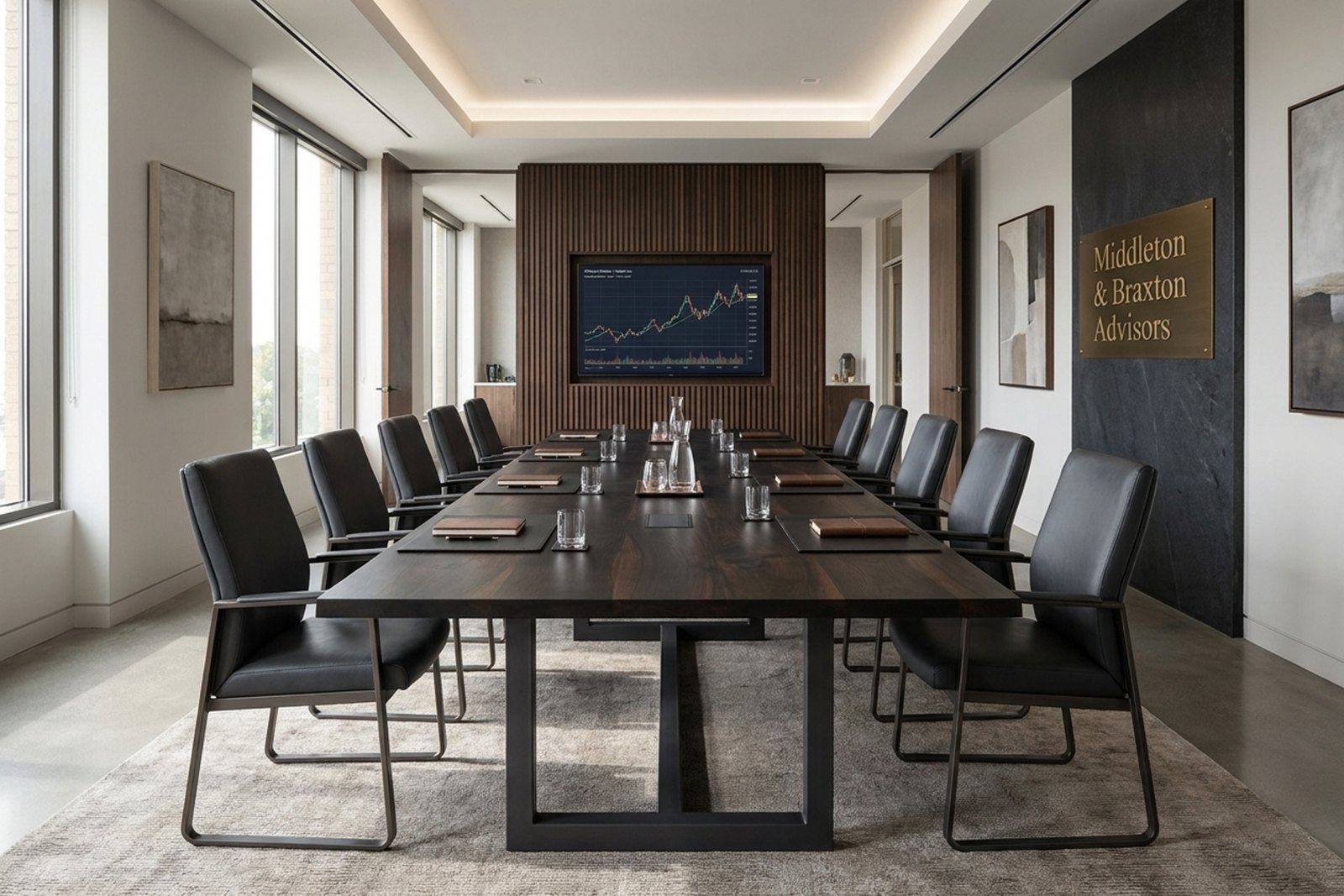
What can you customize on a conference table?
Nearly everything that changes how the table fits the room: length, width, wood, finish, edge, base and power. The shape of each model and its base design stay fixed, because that is what the model is. Everything in the table below is set per order.
| What you choose | Options | Good to know |
|---|---|---|
| Length | 7 to 20 ft (84 to 240 in) | Tops over what your building can take come in two bolted sections |
| Width | 36, 42, 48, 54 or 60 in | 48 in suits most rooms up to 20 ft long |
| Top | 1.5 in solid hardwood | The same thickness on every model |
| Species | Black walnut, white oak, red oak, hard maple | The menu varies by model |
| Finish | Clear, natural, cotton white, black, jet black | Which finishes apply depends on the species |
| Edge | 1/8 in roundover, 1/4 in roundover, eased, 1/4 in chamfer | The 1/8 in roundover is the default |
| Base | The model’s own base, in steel or wood | Steel is powder coated satin black |
| Power | Flush power and data modules, cable tray | Placed to the seats, not the center of the top |
Two things are worth deciding before anything else. The length sets the seat count at about 30 inches of table edge per person, and the width decides whether people across from each other can talk without leaning in. Get those right and the rest is taste.
How are our custom conference tables built?
In the same order every time, from rough boards to a crated table. A made-to-order table is not a stock table cut down. The top is glued up for your size from the start, so the boards run the full length you ordered.
- We mill the rough lumber flat and straight, then sort the boards so color and grain flow down the length of the top
- The boards are edge glued into one panel. They are random widths, usually 4.5 to 9 inches, which is what real solid lumber looks like
- The panel is flattened on our CNC to a finished 1.5 inches, then cut to your exact length and width
- The edge profile is routed, and recesses for the steel stiffeners are cut into the underside
- Every surface is sanded through five grits, from 80 up to 220
- The finish goes on in two coats and cures before anything else touches the top
- The steel base is cut, welded, ground smooth and powder coated, or the wood base is built from the same species as the top
- Threaded inserts go into the underside so the base bolts on without a single screw showing
- The table is assembled, inspected, taken back apart and packed for the truck
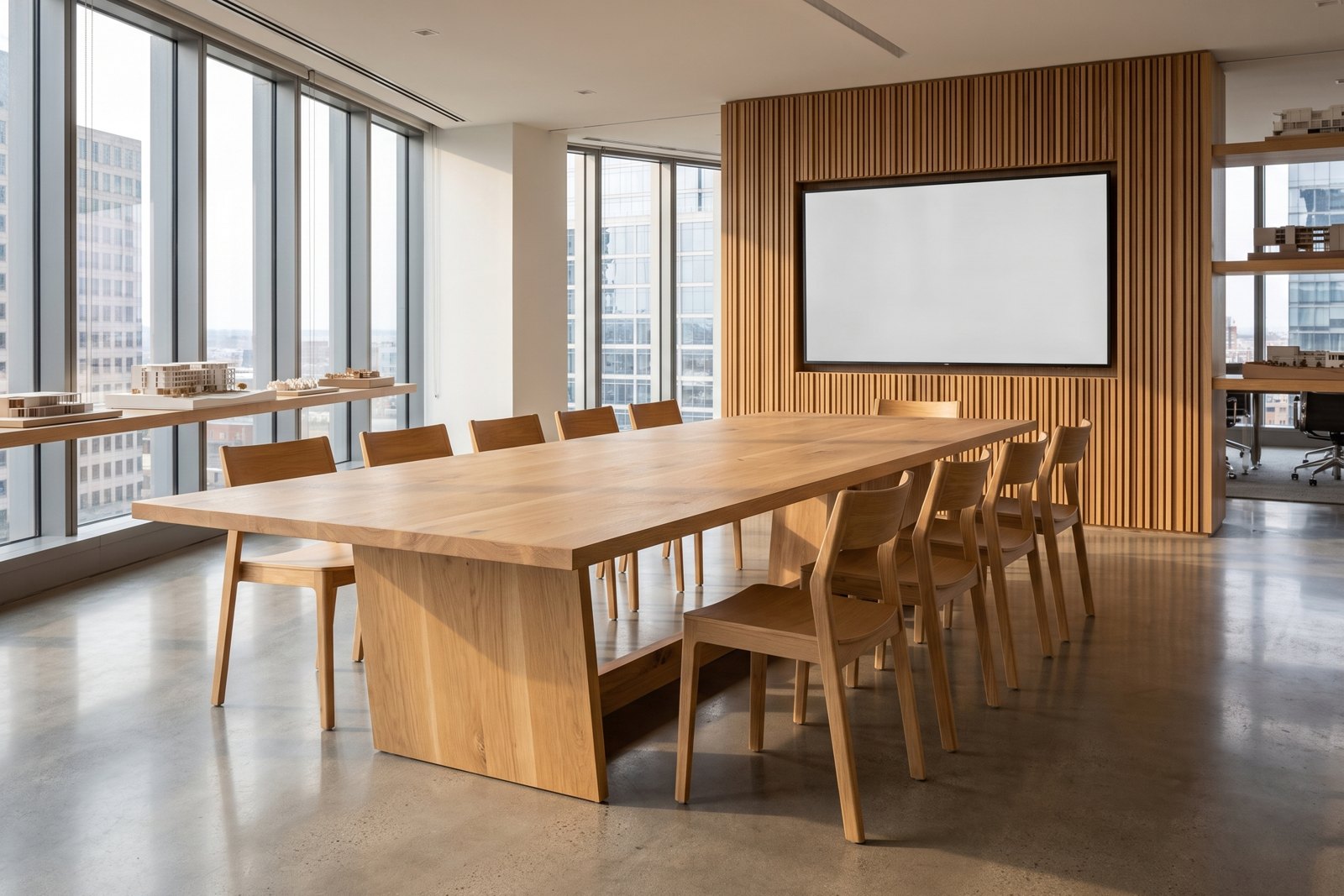
Why does a solid wood top stay flat?
Because steel channels are set into the underside, running across the width. A wide solid top wants to cup a little as the seasons change, and the channels hold it flat while still letting the wood move.
The channels sit in routed recesses so they are flush with the underside and invisible from a chair. A typical top gets two, one about 6 inches from each end, and a top longer than 10 feet gets a third in the middle. They are fastened through round holes every 6 inches that are drilled oversize on purpose, so the wood can expand and shrink without splitting. That small detail is a large part of why a solid table lasts decades and a veneered one usually does not. Our solid wood versus veneer guide covers the rest of that difference.
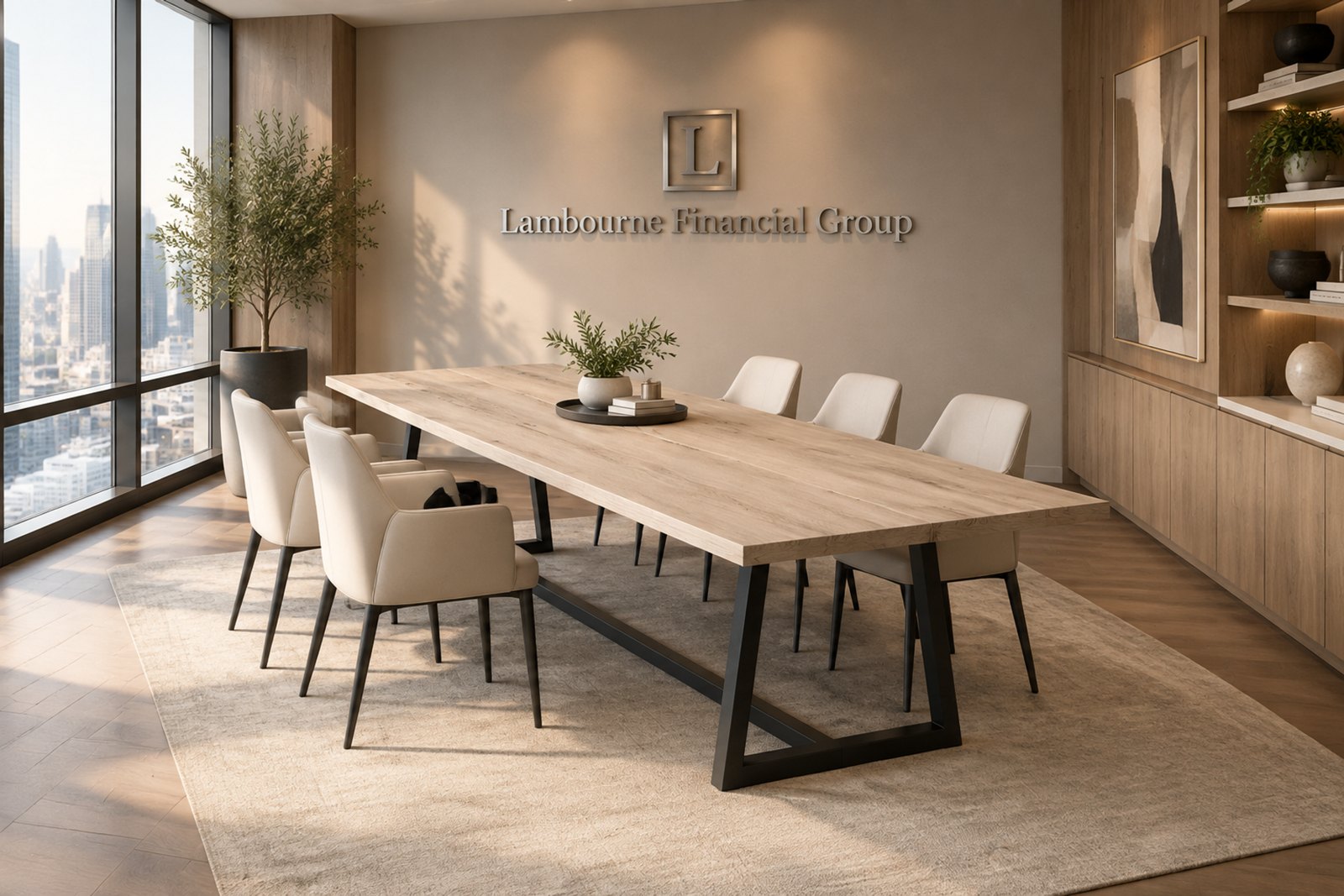
What is the base made of?
Welded steel tube on most models, or solid hardwood on the panel and pedestal designs. Both are built in our shop.
- Standard steel bases use 2 inch square tube. Lighter designs use 1.5 inch tube and statement bases use 3 inch
- Every weld is ground smooth and blended, so the frame reads as one piece rather than parts bolted together
- Steel is powder coated satin black, which holds up better than paint
- Every base gets adjustable leveling feet, because no conference room floor is truly flat
Where the base sits matters as much as what it is made of. A base set in from the ends keeps the end seats usable, and corner legs give them away. Each product page shows where its base lands.
Which wood and finish should you choose?
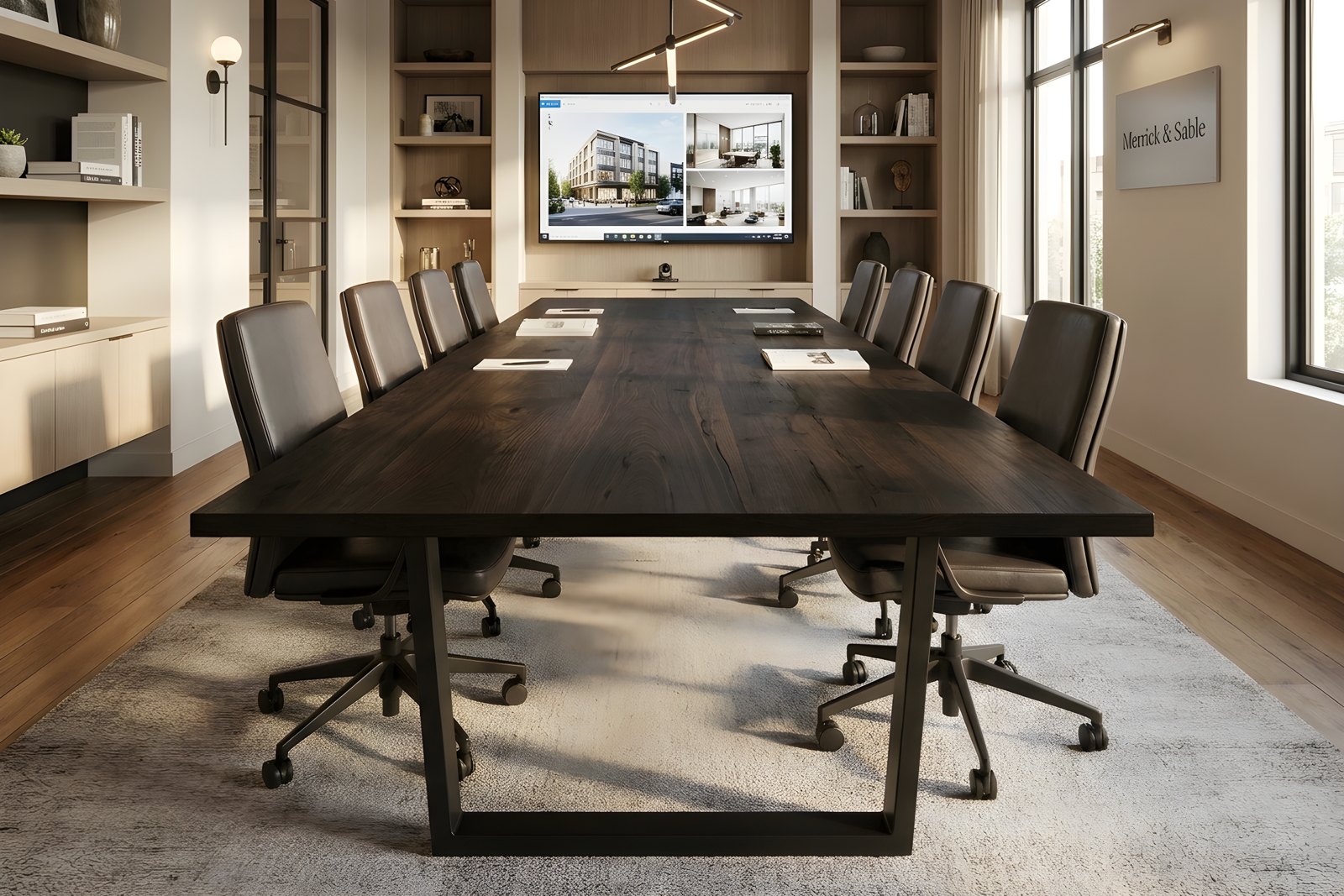
Black walnut for a room that mostly hosts clients, white oak or hard maple for a room in use all day. Red oak sits in between and takes a black stain well. All four are solid hardwood sourced in the USA, and the color will move from board to board down the length, which is how you can tell a solid top from a printed one.
| Species | Finishes | Janka hardness | How it reads |
|---|---|---|---|
| Black walnut | Clear, black | 1,010 lbf | Deep brown with the most color variation |
| White oak | Clear, natural, cotton white, black | 1,360 lbf | Light, even and tight grained |
| Red oak | Clear, jet black | 1,290 lbf | Open grain and a warmer tone |
| Hard maple | Clear | 1,450 lbf | Pale, quiet and the hardest of the four |
Walnut, white oak and red oak are finished with a hardwax oil worked into the wood, so a scratch can be spot repaired instead of refinishing the whole top. Hard maple gets a sprayed clear coat that keeps it from yellowing. For a closer look at one species, our white oak conference tables page shows it in every finish.
What changes when a table is made to order?
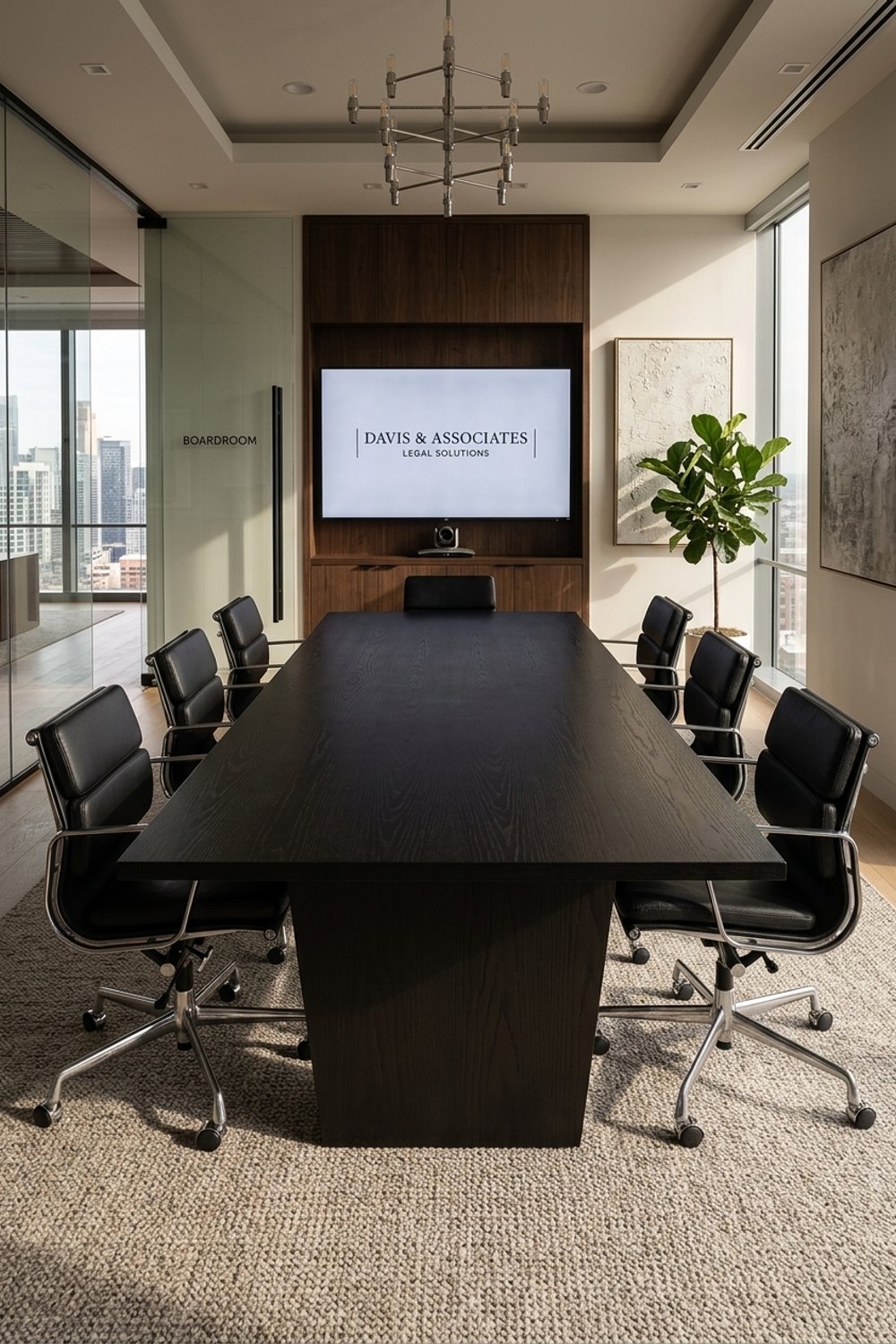
The table fits the room instead of the room fitting the table. A stock table comes in a few lengths and you take the closest one. A made-to-order table is built to the measurement you send.
- The length matches your room to the inch, so you keep the walkway behind the chairs
- The width matches how the room is used, narrow for a training room and wider for a boardroom with screens
- The species and finish can match a reception desk, credenza or desks you already have from us
- Power is placed where the seats are, rather than one grommet in the middle that half the room cannot reach
- Long tops are planned around your building, so a table that will not fit the elevator is built in sections from the start
How does delivery and setup work?
The table ships with the base off and goes together in about five minutes with a drill. The threaded inserts are already in the top and labeled, so the bolts only go one way.
A top can be built in one piece up to 20 feet if your building can take it. When the elevator, stairwell or loading dock cannot, we build it in two sections that bolt together on site with a support under the seam. Our conference tables over 16 feet guide covers how the longest tables are sectioned and delivered. Before you order, send us a few measurements so the table fits through the door as well as the room:
- The clear length and width of the room, wall to wall
- The narrowest door, hallway or elevator the top has to pass through
- Where the floor outlets or floor boxes are, if any
- Any screen or camera wall, so we can keep that end clear
Conference tables we build to order
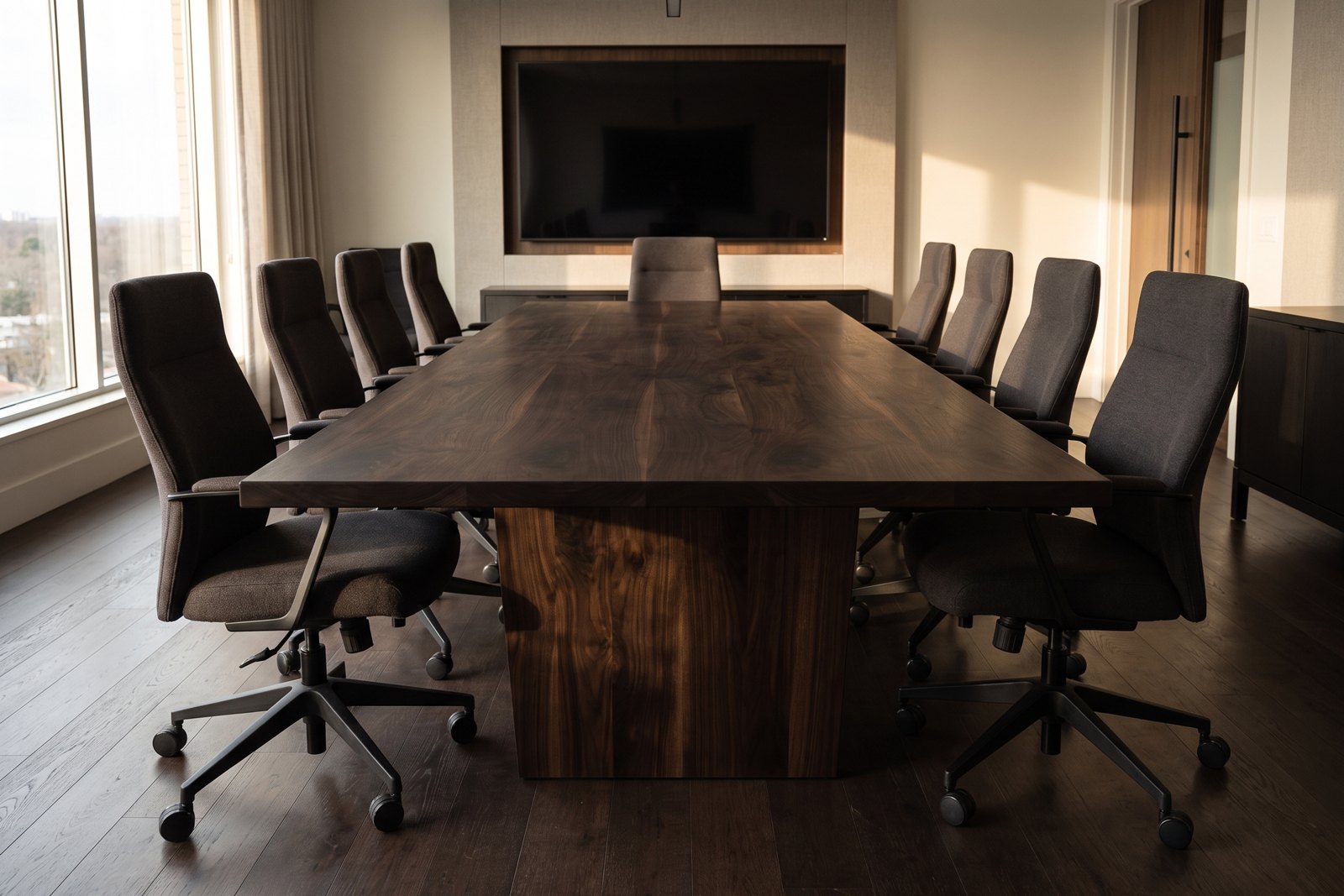
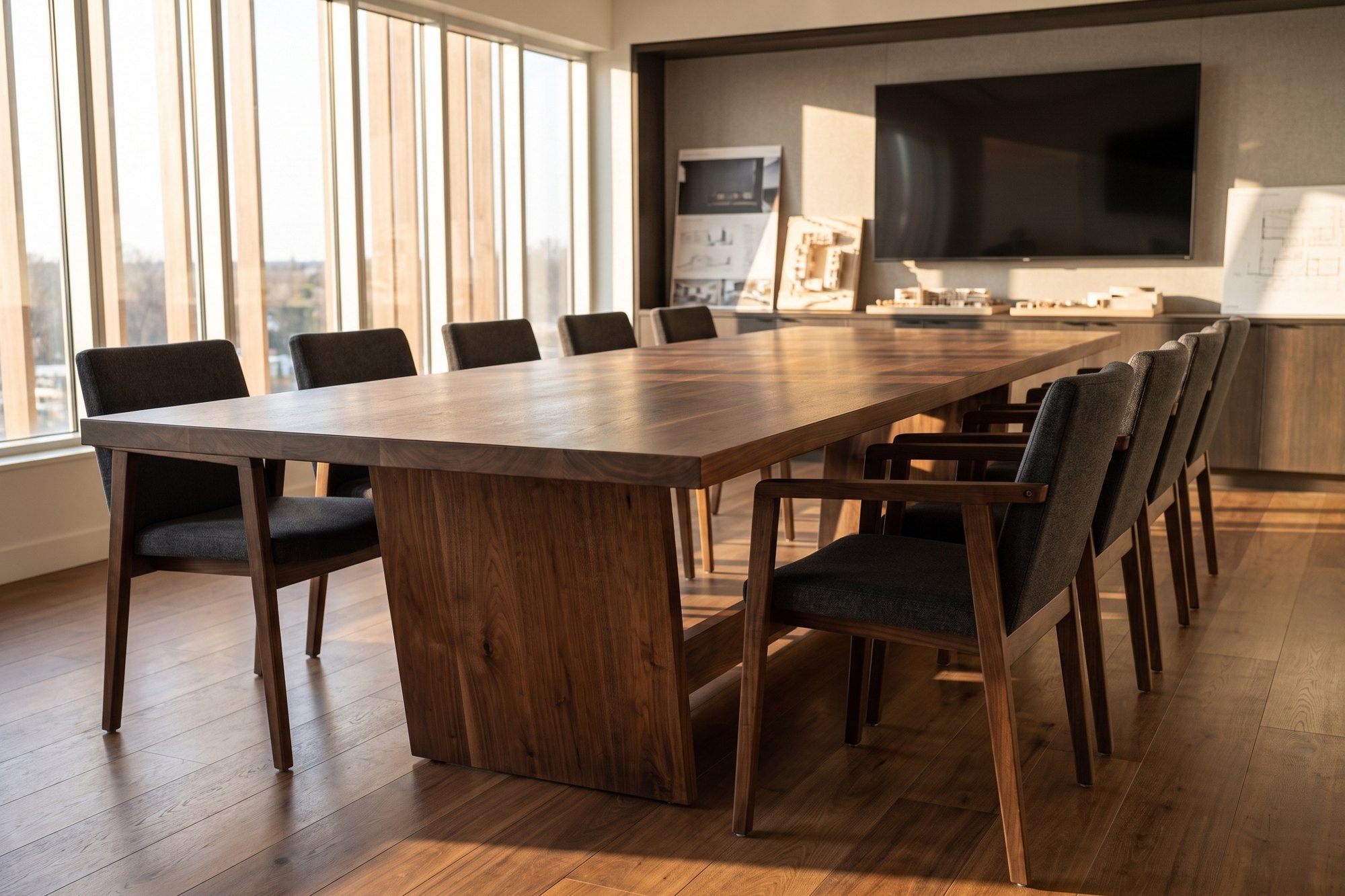
Each model below is built to order. Pick the base you like, then set the length, width, species and finish on its page.



>
Frequently asked questions
What sizes can a custom conference table be built in?
Lengths from 7 to 20 feet. Widths are 36, 42, 48, 54 or 60 inches. Every top is 1.5 inches of solid hardwood.
What wood are custom conference tables made from?
Solid black walnut, white oak, red oak or hard maple, sourced in the USA. The species menu varies by model, and each product page lists what that model is offered in.
Is a custom conference table solid wood or veneer?
Solid wood. The top is edge glued from full thickness hardwood boards and flattened to 1.5 inches, with steel channels underneath to keep it flat as the seasons change.
Can a long conference table fit through a small elevator?
Yes, if we plan for it. A top can be built in one piece up to 20 feet, or in two sections that bolt together on site when the elevator, stairs or dock cannot take one piece.
How is a custom conference table delivered and set up?
It ships with the base off. The threaded inserts are already in the top and labeled, so attaching the base takes about five minutes with a drill.
How long does a custom conference table take to build?
Every table is made to order in Fargo, North Dakota, and production starts when the order is placed. The current production time is listed on each product page.
Build yours to the room
Start with the room size and the seat count, then choose a base, a species and a finish. Every table is made to order in Fargo, North Dakota.
Trusted by Industry Leaders