
A maple conference table is the one to pick when the room needs to stay light. Hard maple is the palest of our four species and the hardest, rating 1,450 on the Janka scale against white oak’s 1,360 and walnut’s 1,010.
We build them in solid hard maple at any length from 84″ to 288″ (7 to 24 ft) and widths from 36″ to 72″. Every table in the collection is available in maple, and every maple table can be built in another species instead.

The collection in maple
Each of these builds in solid hard maple, at any length in 12″ increments.
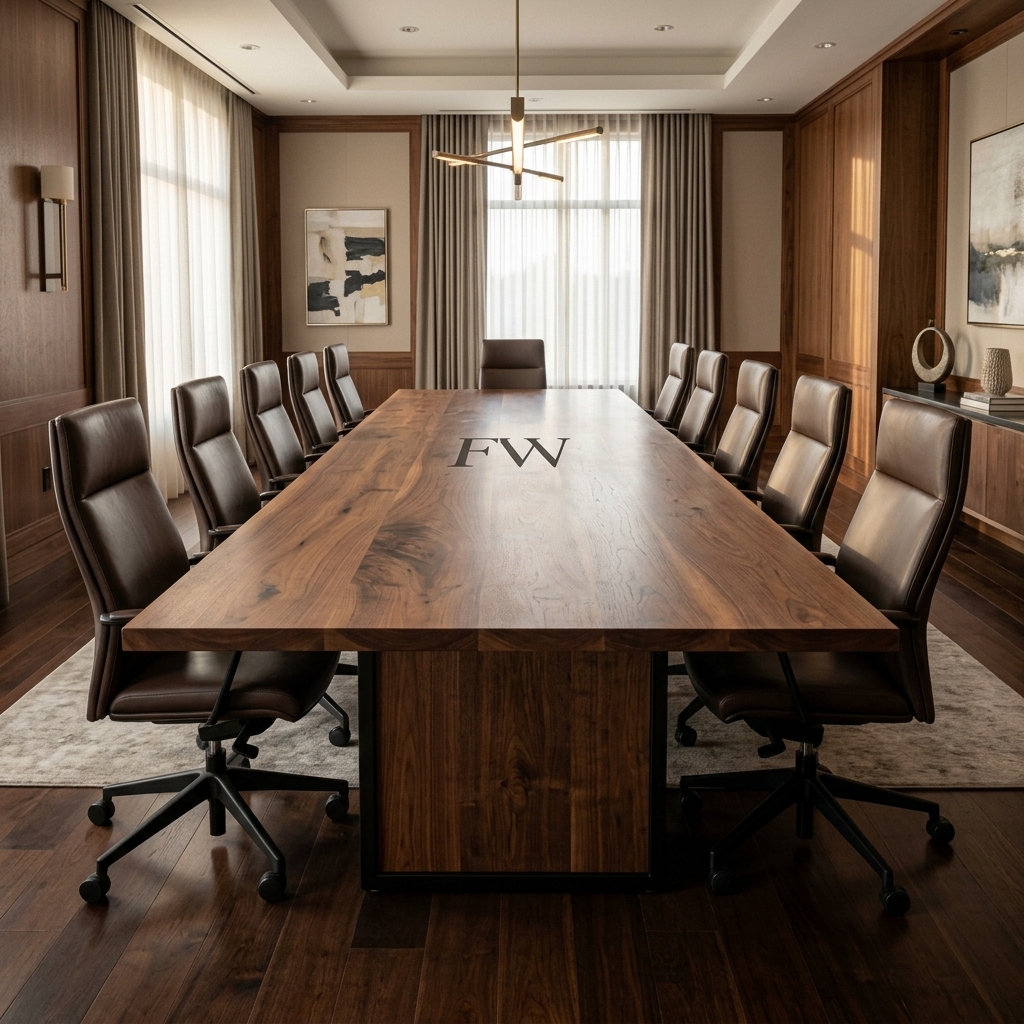 Hartford Conference TableDesign yours
 Cassian Conference TableDesign yours
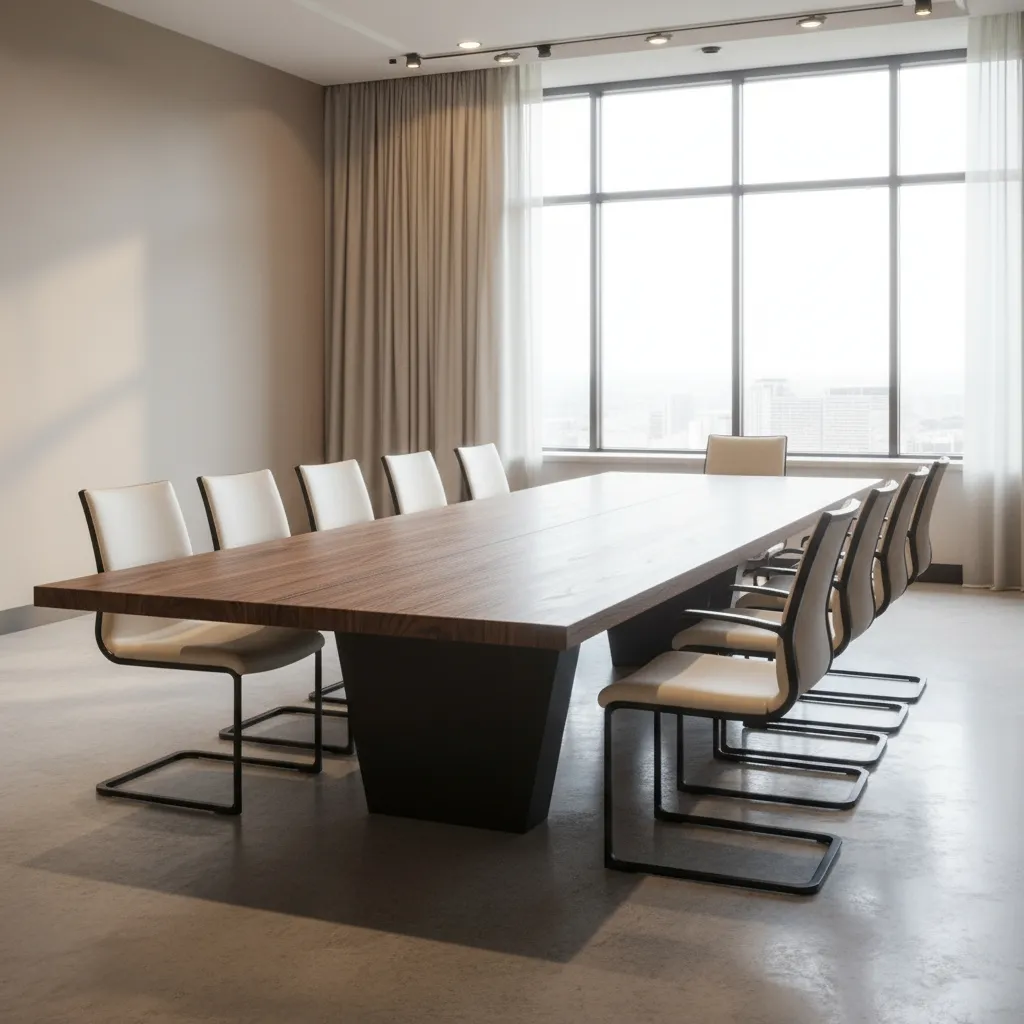 Cascade Conference TableDesign yours
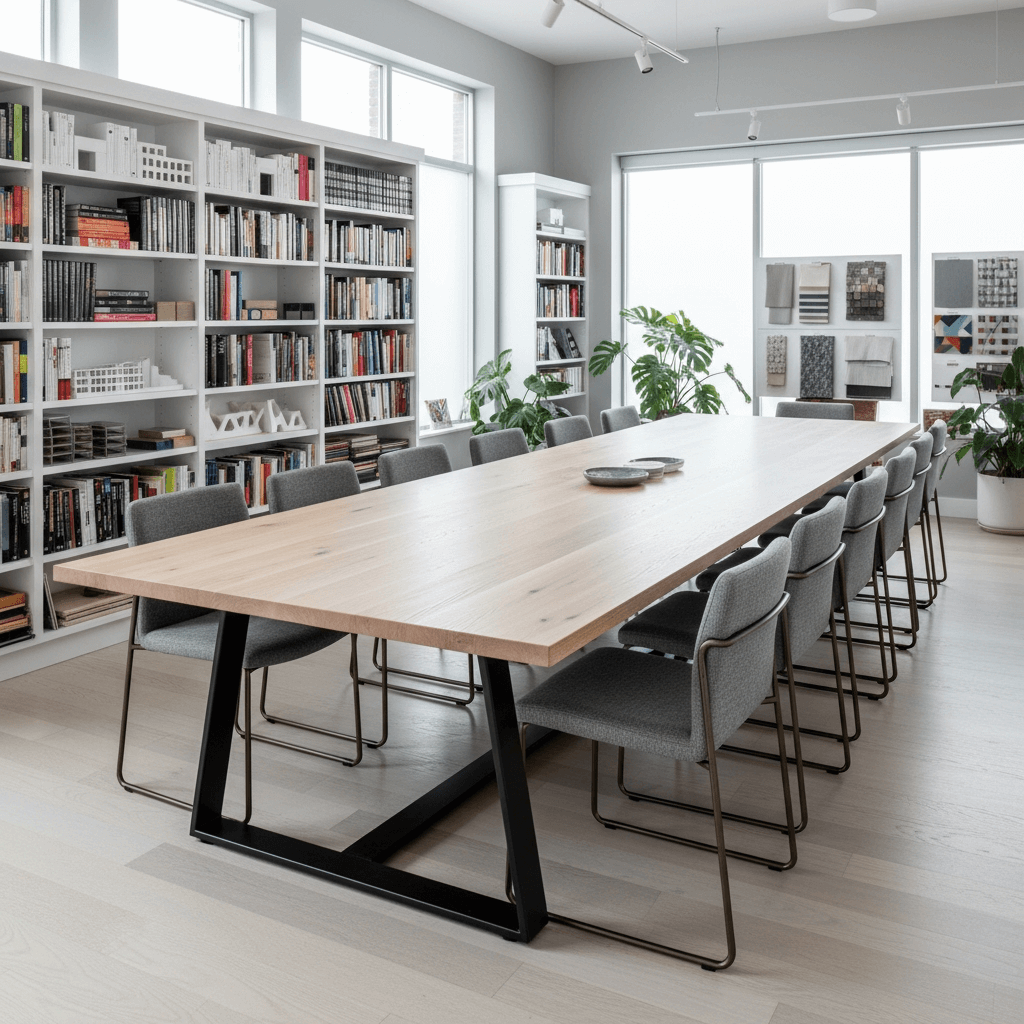 Horizon Conference TableDesign yours
 Bennett Conference TableDesign yours
 Apex Conference TableDesign yours
 Boulder Conference TableDesign yours
 Broadway Conference TableDesign yours
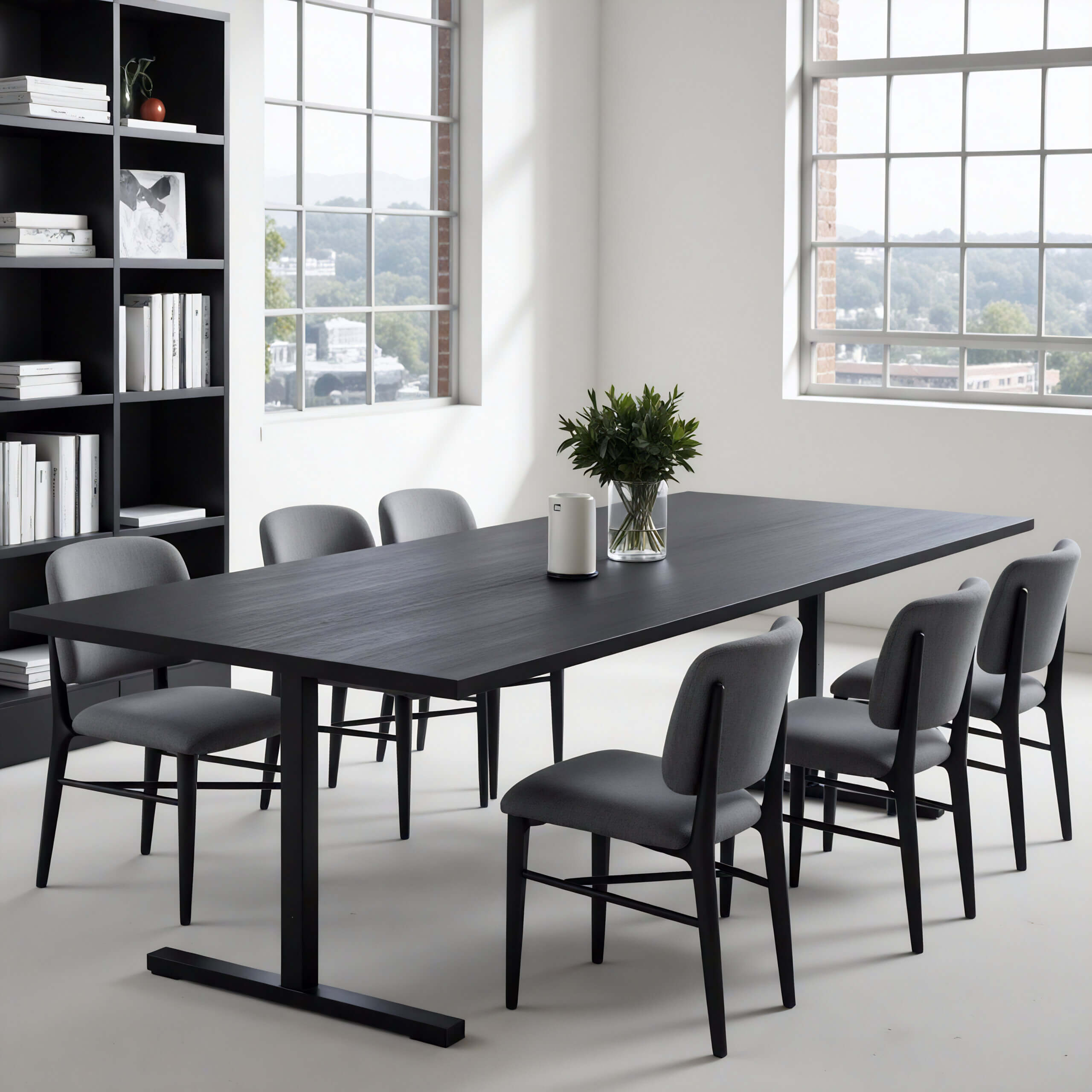 Sequoia Conference TableDesign yours
Why choose a maple conference table?
Two reasons. It is the hardest species we stock, so a table that gets used every day holds up. And it is pale and close-grained, which makes a small or north-facing room read brighter than oak or walnut would.
The trade-off is honest: pale wood shows marks more readily than dark wood does. The hardwax oil finish is repairable in place, so a ring or a scuff is a spot repair rather than a refinish.

How big can a maple conference table be?
Lengths run 84″ to 288″ in 12″ increments. A 96″ table seats 8, a 144″ seats 12, a 192″ seats 16 to 18, and a 288″ seats 24. Widths are 36″, 42″, 48″, 54″, 60″, 66″ and 72″. Standard height is 30″.
Allow 30″ of table edge per person and 36″ to 48″ of clearance behind the chairs when you size the room.

Finishes on maple
Clear keeps maple close to its raw color, which is where most of the appeal is. Rubio natural warms it a shade. Cotton white pushes it lighter without turning it into paint. Black is available but works against the reason most people choose maple.

Maple against oak and walnut
Maple is the hardest and the palest. White oak is nearly as hard with more visible grain and a warmer cast. Walnut is the softest of the three and the darkest, and it hides wear best. If the room is dark, maple. If it needs to feel serious, walnut. White oak sits between them.
Length, seating and room size
Every length below is a real build, not a stock size. Seating assumes 30″ of table edge per person and a base that leaves both ends clear. Room size assumes 36″ to 48″ of walking clearance on every side.
| Length | Seats | Room needed |
|---|---|---|
| 84″ (7 ft) | 6 | 14′ x 16′ |
| 96″ (8 ft) | 8 | 16′ x 18′ |
| 120″ (10 ft) | 10 | 18′ x 20′ |
| 144″ (12 ft) | 12 | 20′ x 22′ |
| 168″ (14 ft) | 14 | 21′ x 23′ |
| 192″ (16 ft) | 16 to 18 | 22′ x 24′ |
| 240″ (20 ft) | 20 to 22 | 24′ x 28′ |
| 288″ (24 ft) | 24 | 26′ x 32′ |
Widths run 36″, 42″, 48″, 54″, 60″, 66″ and 72″. Under 48″ a table gets tight once laptops and papers are out; over 60″ it becomes hard to pass anything across. Most boardrooms land at 48″ or 54″.
Shapes
Rectangular is the default and the most seat-efficient. A boat shape conference table bows the long edges outward at the center, which lets everyone at the table see everyone else without leaning. The boat shape costs a little seating for a real gain in sightlines, and at 14 ft and up it is worth considering.
- Rectangular. Most seats per foot, simplest to place, works in any room.
- Boat shape. Bowed sides, better sightlines end to end, ideal for video calls.
- Racetrack. Rounded ends, softer in a room with a lot of glass.
- U-shape. For training rooms and presentations where everyone faces one wall.
Power and cable management
Cable management is the detail that decides whether a boardroom table stays usable. We machine the top for flush power and data modules and run a concealed channel or tray under the spine so nothing hangs. At 12 ft and up one center grommet does not reach, so plan two runs.
- Flush pop-up power and USB-C modules, set into the top where you want them.
- A concealed cable tray or spine channel so nothing is visible from a seat.
- A floor-box drop or a single leg chase, depending on where the power comes up.
- Video and network pass-through machined at the presentation end.
What goes around it
We build the table, not the seating, and that is worth saying plainly. Allow 26″ to 30″ per chair and check the arm height against a 30″ apron before you order office chairs, since arms that do not tuck cost you real seats. For rooms that double as training space, training tables on casters along the wall keep the boardroom table clear.
Care
Hardwax oil is repairable in place, which is the whole reason we use it. A ring or a scratch is a spot repair with oil and a cloth rather than a full refinish. Wipe spills rather than letting them sit, keep the room between 35 and 55 percent humidity so seasonal movement stays small, and re-oil high-traffic areas about once a year.
Common questions
Is maple good for a conference table?
Yes. Hard maple rates 1,450 on the Janka hardness scale, harder than white oak at 1,360 or walnut at 1,010, so it stands up to daily use.
How many people fit at a maple conference table?
It depends on length: 8 at 96″, 12 at 144″, 16 to 18 at 192″, up to 24 at 288″. Allow 30″ of edge per person.
Can any conference table be built in maple?
Yes. Every table in the collection is available in solid hard maple, in clear, natural or cotton white.
Build yours in maple
Set the length, the width and the finish. Made in Fargo, North Dakota.
Trusted by Industry Leaders