
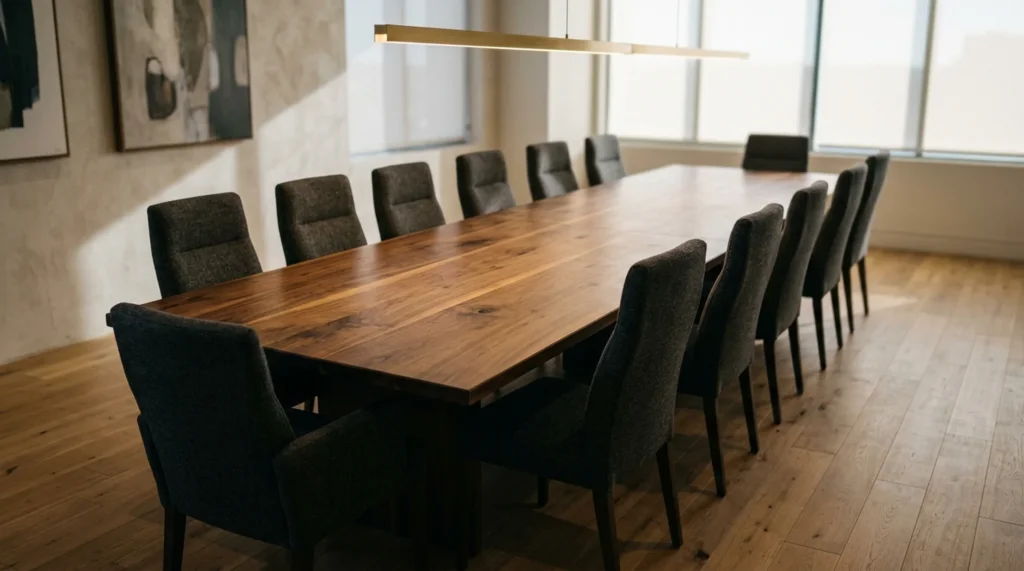
Nailing the right conference table seating capacity is key to productive and comfortable meetings. Too little space leads to cramped interactions, while too much can make a room feel sparse. This guide provides clear rules for allocating 30–42 inches of surface per person, explores how different table shapes—from classic rectangular to versatile modular—affect seating numbers, and covers essential aspects like clearance, ergonomics, customization, and tech integration. You’ll find standard dimensions for tables seating 6 to 14 people, learn how chair types and room layouts impact capacity, and get expert advice on cable management and hybrid setups. Whether you’re looking for ready-made conference tables or custom conference tables to perfectly fit your space, you’ll gain the insights needed to boost seating efficiency, comfort, and collaboration.
What's the Ideal Space Per Person for Conference Table Seating?
Ensuring the right amount of linear space per person is fundamental for comfort, productivity, and ergonomic support at any boardroom or huddle table.
How Much Table Space Does Each Person Need for Comfort and Productivity?
Each attendee generally needs 30–36 inches of table edge to comfortably manage notes, laptops, and refreshments. Opting for 36–42 inches provides ample workspace for binders, dual monitors, or collaborative documents. While 30 inches per person can work for high-density seating with minimal foot traffic, planning for 36 inches promotes comfort during longer meetings and aligns with best practices for productive board sessions.
How Do Different Chair Types Affect Seating Space Requirements?
The profile of your chairs significantly influences the space needed behind and beside each seat:
- Executive chairs with substantial armrests require an additional 4–6 inches of width compared to slimmer, armless task chairs.
- High-back armchairs need more knee clearance, potentially increasing the required distance between the table and the wall by 2–3 inches.
- Swivel bases need about 18–24 inches of clear space for a full 360-degree rotation to prevent collisions with neighboring seats.
Factoring in these chair variations ensures each participant can adjust their position without encroaching on others.
What Are the Ergonomic Principles Behind Conference Table Seating?
Understanding core ergonomic principles is vital for creating comfortable and productive work environments.
Ergonomic seating focuses on height, depth, and reach to minimize fatigue and encourage healthy posture. By matching the tabletop height (typically 30 inches) with chair seat height (18–20 inches), participants can maintain a 90-degree elbow angle for writing or typing. Ensuring at least 24 inches of clear knee space beneath the table prevents restricted leg movement, while curved or boat-shaped edges reduce forearm pressure. These principles contribute to sustained comfort and focus during extended meetings.
The application of ergonomic principles extends beyond just seating to encompass the overall design of work environments.
Understanding individual space needs naturally leads to selecting the most efficient table shape for your meeting objectives.
How Do Conference Table Shapes Influence Seating Capacity?
The geometry of a table directly impacts seating capacity, sightlines, and how participants interact.
What Are the Seating Capacities of Rectangular Conference Tables?
Rectangular tables offer the most edge length per linear foot and are ideal for formal boardroom settings. Their straight sides allow for evenly distributed seating, typically accommodating two people per 3-foot section along the long edges, plus one person at each end. This shape also simplifies the routing of cables and power modules down the center.
How Many People Can Fit Around Round and Square Tables?
Round tables promote egalitarian discussion by eliminating hierarchical “head” positions and require 36–60 inches of diameter per 4–6 seats. A 5-foot round table comfortably seats 6, while a 6-foot round table can accommodate 8 with 36–42 inches of space per person. Square tables offer similar seating density to round tables but bring participants into closer proximity, enhancing conversation in smaller spaces.
What Are the Advantages of Boat-Shaped and Oval Tables for Seating?
Boat-shaped and oval tables balance ample edge length with improved sightlines, featuring a curved center that enhances visibility across the table. These shapes often seat the same number of people as a rectangular table of the same length but offer angles that reduce peripheral glare and facilitate easier eye contact. For instance, a 10-foot boat-shaped table can comfortably seat eight people along the sides, with its gentle inward curve directing attention toward presenters or screens.
How Do Specialty Shapes Like U-Shaped and Modular Tables Affect Seating?
U-shaped and modular systems are highly adaptable for various meeting formats, allowing for open discussions or panel-style presentations. U-shaped configurations, formed by three rectangular sections, can seat presenters at the open end and attendees along the wings, often increasing capacity by up to 20% in larger rooms. Modular tables allow facilitators to reconfigure segments into clusters, auditoriums, or breakout pods, supporting hybrid workflows and team workshops.
A comparative look at shapes and their seating capacities follows, illustrating how form dictates function.
| Shape | Typical Seats | Recommended Dimensions |
|---|---|---|
| Rectangular | 6–14+ | 6–14 ft length × 3–4 ft wide |
| Round | 4–12 | 5–7 ft diameter |
| Square | 4–8 | 4–6 ft side |
| Boat-Shaped/Oval | 6–12 | 8–14 ft length × 3–4 ft wide |
| U-Shaped/Modular | Varies | Custom modular segments |
What Are the Standard Conference Table Dimensions by Seating Capacity?
Selecting a table based on your planned headcount simplifies procurement and room planning.
What Are the Dimensions for 6-Person Conference Tables?
Tables designed for six people typically measure 6 feet long by 3 feet wide, providing 36 inches of space per person along the two long sides. This size fits well in rooms as small as 10×12 feet, allowing for adequate clearance around the perimeter.
How Big Should an 8-Person Conference Table Be?
Rectangular tables for eight people are usually around 8 feet long and 3.5 feet wide, ensuring each attendee has 36 inches of table edge. Round tables for eight require a minimum diameter of 6 feet to maintain comfortable spacing.
What Are the Dimensions for 10- and 12-Person Tables?
Rectangular tables for 10 and 12 people typically range from 10–12 feet in length and 4 feet in width, offering 30–36 inches of space per side seat plus room for individuals at the ends. Oval versions of these lengths can enhance sightlines without significantly increasing the room footprint.
How to Size Large Conference Tables for 14 or More People?
For groups of 14 or more, consider modular table segments or boat-shaped tables that are 14–20 feet long and 4–5 feet wide to accommodate presentations and equipment. Modular designs allow for easy expansion by adding 2-foot sections for every two additional seats needed.
| Seating Capacity | Length | Width |
|---|---|---|
| 6 persons | 6 ft (1.8 m) | 3 ft (0.9 m) |
| 8 persons | 8 ft (2.4 m) | 3.5 ft (1.1 m) |
| 10 persons | 10 ft (3.0 m) | 4 ft (1.2 m) |
| 12 persons | 12 ft (3.7 m) | 4 ft (1.2 m) |
| 14+ persons | 14–20 ft (4.3–6.1 m) | 4–5 ft (1.2–1.5 m) |
These standard dimensions serve as a reliable starting point for both readily available conference tables and custom conference tables designed for specific spatial needs.
How Much Room Clearance Is Needed Around Conference Tables for Comfort?
Adequate clearance is essential for easy movement, safe egress, and ADA compliance.
What Is the Recommended Clearance Distance Between Table and Walls?
Allow a minimum of 3 feet (36 inches) between the table edge and surrounding walls or large furniture pieces. This space enables chairs to tilt back comfortably and allows attendees to pass by easily. For catering setups or demonstration areas at the table’s head, aim for 4–5 feet of clearance.
How Does Other Furniture Affect Conference Room Layout and Clearance?
Credenzas, storage units, and presentation consoles require an additional 2–3 feet of aisle space beyond the basic clearance. If placing sideboards along walls, ensure there’s 36 inches of clear space in front for access and about 18 inches behind for service carts or AV equipment.
How to Optimize Traffic Flow and Accessibility in Conference Rooms?
Position the table parallel to doorways to create clear pathways for entry and exit. Maintain 5-foot-wide corridors at entrances to accommodate two-way traffic and consider using pathway markers for visually impaired guests. Integrating recessed power and cable management systems beneath the tabletop helps prevent tripping hazards and keeps flooring unobstructed.
Sufficient clearance transforms a potentially crowded room into a flexible, inclusive environment that can adapt to various meeting formats.
How Can You Customize Conference Tables to Fit Unique Seating Needs?
Customization offers a tailored approach to meeting space design, ensuring optimal functionality and aesthetics.

Custom solutions allow you to precisely tailor capacity, aesthetics, and functionality to your brand identity and room dimensions.
What Are the Benefits of Custom Conference Tables for Seating Capacity?
Custom conference tables enable exact edge lengths, unique shapes, or integrated extensions to perfectly match your seating requirements. By specifying non-standard widths or adding leaf sections, organizations can optimize floor space while still accommodating all necessary attendees. Custom veneers, integrated logos, and bespoke apron designs can reinforce corporate branding and enhance the professional image of executive suites.
How Do Modular Designs Enhance Seating Flexibility?
Modular conference tables are composed of interlocking segments—available in rectangular, wedge, or curved forms—that can be reconfigured into pods, U-shapes, or theater-style rows. This adaptability is ideal for multi-purpose spaces that host everything from board meetings and training sessions to team-building events. Quick-release connectors and standardized leg placements allow for rapid reconfiguration in under 10 minutes, maximizing room utilization.
Customization ensures your seating plan can evolve with changing team sizes and meeting types, seamlessly integrating with technology needs.
How Does Technology Integration Affect Conference Table Seating and Layout?
In today’s hybrid workplaces, table design must accommodate AV equipment, power distribution, and camera angles.
What Seating Considerations Are Important for Video Conferencing?
Position participants so that cameras capture their faces directly, avoiding extreme angles that can distort perspective. Seat videoconference presenters at the table ends or within a slight inward curve to maintain eye contact with the remote audience. Plan for cable management systems that power cameras, microphones, and displays without obstructing knee space or creating trip hazards.
How to Incorporate Cable Management and Power Outlets Without Sacrificing Space?
Install modular power and data modules flush with the tabletop surface to provide convenient AC, USB, and network connections at each workstation. Utilize under-table raceways and vertical grommets to discreetly route cables from the tabletop to the floor. This approach preserves the full 36–42 inches of clear edge space for users while ensuring essential technology connectivity.
Well-integrated technology modules maintain valuable tabletop real estate and support dynamic meeting formats.
What Are the Most Common Questions About Conference Table Seating Capacity?
This section provides clear, concise answers to common seating queries, designed for quick reference.
How Many People Can Fit at a 10-Foot Conference Table?
A 10-foot rectangular conference table typically seats 8–10 people, allocating 30–36 inches per side seat and accommodating one person at each end for balanced distribution and comfortable workspace.
What Is the Standard Height of a Conference Table?
Most conference tables are 29–30 inches high, adhering to ergonomic standards that support a 90-degree arm angle when seated in standard office chairs.
How Do You Calculate the Right Conference Table Size for Your Room?
Measure your room dimensions, then subtract 6–8 feet total (accounting for clearance on both long sides and ends). Select a table size that leaves at least 3 feet of aisle space on all sides. Divide the usable perimeter by 30–36 inches to estimate the maximum seating capacity.
What Are the Best Table Shapes for Different Meeting Types?
Rectangular tables are ideal for formal settings and presentation-focused board meetings. Round or square tables encourage intimate collaboration among smaller teams. Boat-shaped and oval designs optimize sightlines for hybrid or executive sessions, while U-shaped and modular layouts are perfect for training, workshops, and multi-purpose environments.
These direct answers will equip you to select or design a table that perfectly matches your seating requirements and room constraints.
Choosing the right conference table seating capacity involves balancing ergonomic principles, shape selection, and clearance planning to optimize every meeting. By following these guidelines—allocating 30–42 inches per person, matching table shape to meeting style, and ensuring 3–5 feet of room clearance—you’ll significantly enhance comfort, productivity, and flexibility. Whether you select standard conference tables or opt for custom conference tables, adhering to these standards guarantees efficient space utilization and a polished meeting environment.
Trusted by Industry Leaders
Join the Journal
New writing, delivered occasionally.
Quiet notes on craft, materials, and finished pieces — sent only when there's something worth reading.