
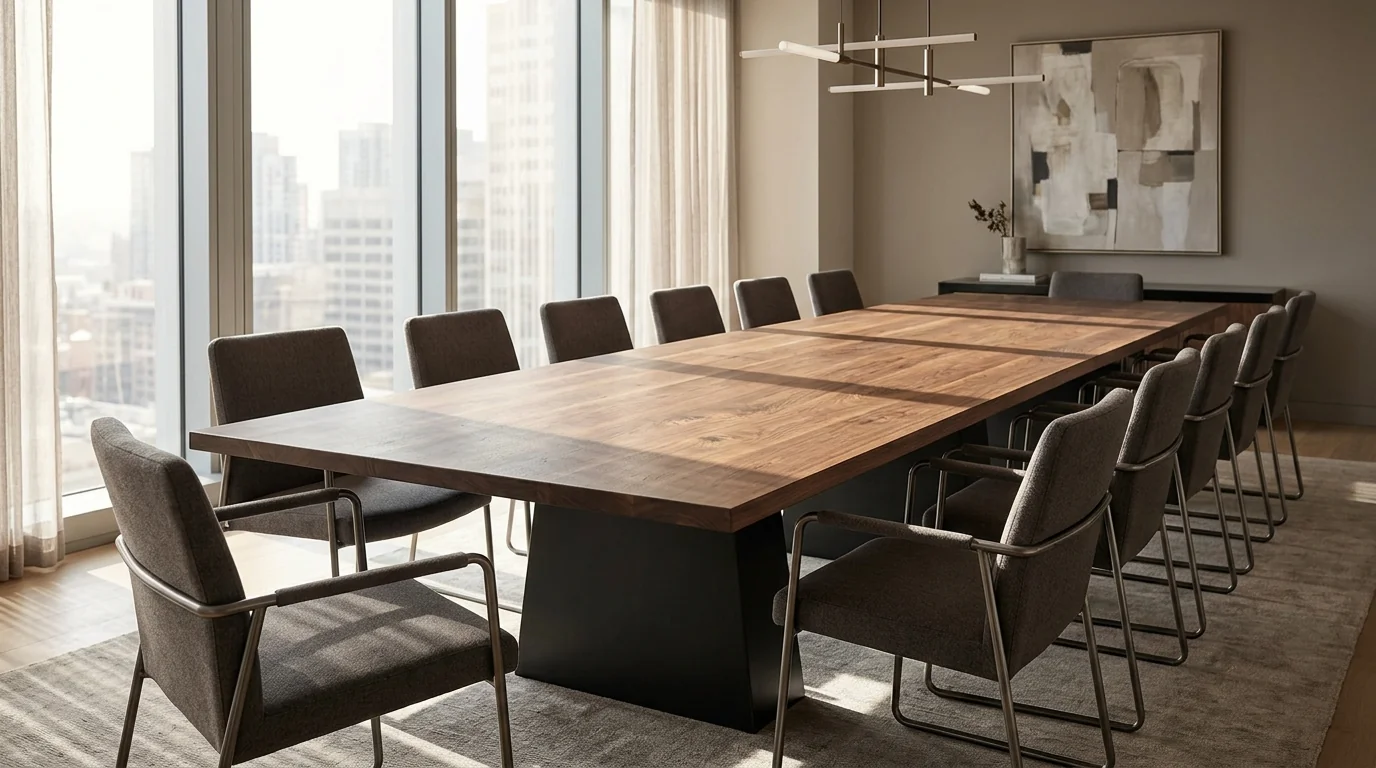
Large Conference Table Styles for Modern Offices: Choosing Custom Modern Boardroom Tables for Executive Meeting Spaces
Large conference table styles shape how teams communicate, how authority is perceived, and how technology fits into the meeting workflow. This guide explains the most popular large conference table styles for modern offices and translates design choices into practical outcomes for seating, sightlines, durability, and tech readiness. Readers will learn style-by-style benefits, which solid wood materials perform best in high-use commercial settings, how to plan power and cable management, and the sizing rules that avoid costly rework. The article also covers 2025 trends—modularity, biophilic touches, and minimalist details—and shows how custom-build options can future-proof executive boardrooms. Each section pairs clear rules-of-thumb with examples and practical checklists so facilities teams and design decision-makers can specify the right table for their space.
What Are the Most Popular Large Conference Table Styles for Modern Offices?
Large conference table styles vary by meeting intent: formal decision-making favors linear forms while collaborative sessions benefit from curved or modular systems. Rectangular tables create ordered sightlines and defined head positions, supporting formal boardroom protocol and AV layouts; boat-shaped and oval tables reduce hierarchy and improve eye contact for collaborative sessions; round tables promote equality but are less suited to very large groups; modular systems allow reconfiguration for hybrid schedules. Understanding these functional differences helps buyers choose shapes that match meeting behavior and room geometry, which also informs material and power planning in subsequent sections.
How Do Rectangular Conference Tables Support Formal Boardroom Settings?
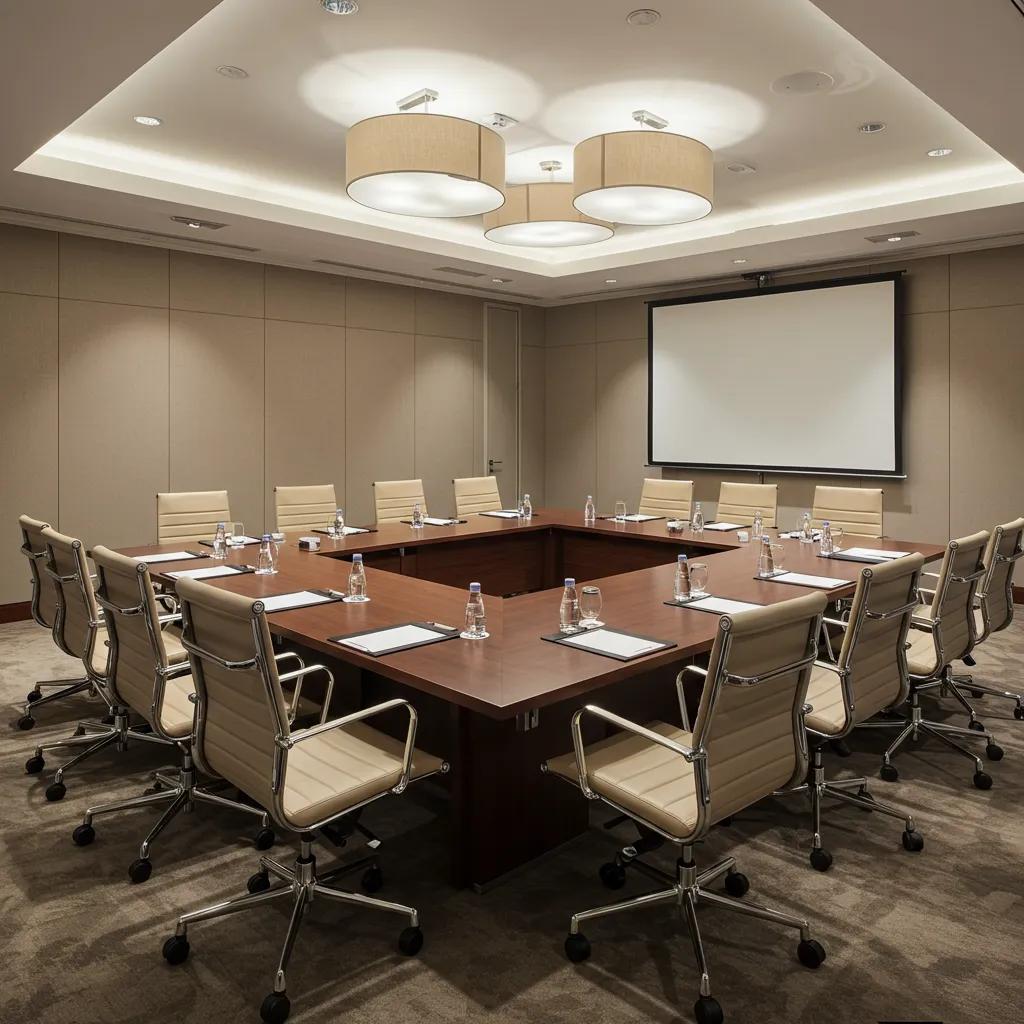
Rectangular conference tables define a central axis for seating hierarchy, AV placement, and linear sightlines, which supports structured agenda-driven meetings. The geometry makes it straightforward to mount video displays on a long wall and to route power along the table’s center or through periodic grommets, improving AV predictability. Typical dimensions for formal settings scale from eight to twenty seats depending on length, and straight edges simplify circulation planning and chair alignment. Because rectangular designs emphasize formality, they pair well with robust bases and clean edge details that tolerate foot traffic and rolling chairs, and this leads naturally into why curved shapes often favor collaboration.
Why Choose Boat-Shaped and Oval Tables for Enhanced Collaboration?
Boat-shaped and oval tables moderate hierarchy by softening sightlines and bringing participants visually closer, which promotes discussion and shared attention. Curved ends reduce distance between people at opposite sides of the table, improving nonverbal communication and making moderators less visually dominant, an effect useful for brainstorming and inclusive leadership styles. These shapes handle larger seating counts with fewer “end seats” and can integrate perimeter power or center-channel wiring without interrupting the aesthetic flow. Designers often specify oval or boat-shaped tops when they want a modern, approachable boardroom that still supports AV and cable management needs, which we explore further in the technology section.
Which Materials Define Durable and Elegant Solid Wood Conference Table Designs?
Choosing material balances aesthetics, durability, and lifecycle cost; solid hardwoods deliver longevity and repairability that veneer systems rarely match. Hardwoods vary in grain, color, and hardness, which affects scratch resistance and commercial suitability, while finish systems determine maintenance frequency and stain resistance. Below is a practical comparison of common solid woods used for large conference tables so planners can match visual goals to wear expectations and maintenance budgets.
| Wood Species | Durability / Hardness | Grain & Color | Typical Finish |
|---|---|---|---|
| Black Walnut | High durability, moderate hardness | Rich, warm chocolate-brown with variable grain | Oil or satin polyurethane |
| Red Oak | Very high hardness, wear-resistant | Prominent straight grain, warm golden tones | Lacquer or UV-cured finish |
| White Oak | High hardness, excellent stability | Subtle grain, light to medium tan color | Oil, water-based polyurethane |
| Maple | Hard with smooth grain | Pale, uniform color, tight grain | Hard satin finish or UV-cured lacquer |
This species table clarifies tradeoffs: walnut offers striking color and patina, oak variants provide surface resilience for heavy use, and maple gives a clean modern look with good hardness. Choosing the right finish in combination with species reduces maintenance and prolongs finish life.
For commercial buyers focused on customization and long-run durability, Fargo Woodworks offers solid hardwood options that align with these material choices. Our flagship example, The Dakota Conference Table, demonstrates these principles with a durable 2-inch thick butcher-block style top available in Red Oak, Black Walnut, White Oak, and Maple, plus finish and base color customization. The Dakota’s solid hardwood construction illustrates how species choice and finish decisions translate into a boardroom centerpiece that balances aesthetic and functional needs.
What Are the Benefits of Black Walnut, Red Oak, White Oak, and Maple in Conference Tables?
Black Walnut provides a premium, warm tone that develops a rich patina over time and suits executive aesthetics, while Red Oak emphasizes durability with a pronounced grain that hides blemishes in high-traffic rooms. White Oak combines stability with subtle grain—ideal for minimalist or Scandinavian-leaning designs—and Maple delivers a clean, contemporary canvas that accepts stains evenly and resists denting when properly finished. Each species responds differently to aging and refinishing: walnut darkens slowly, oak tends to amber, and maple maintains brightness with protective finishes. Understanding these species behaviors helps procurement teams specify appropriate maintenance cycles and refinishing approaches for long-term value.
How Do Sustainable and Eco-Friendly Materials Influence Modern Office Furniture?
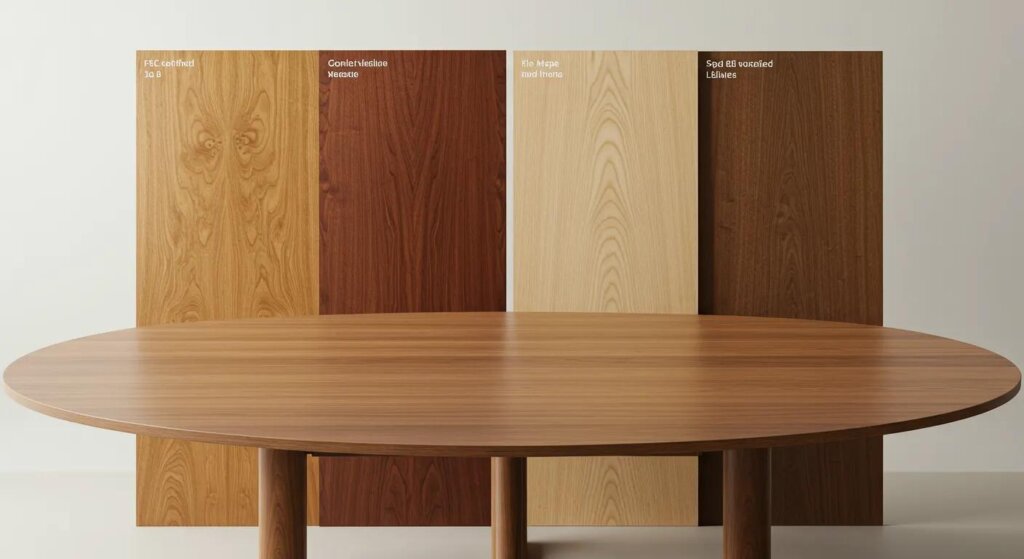
Sustainability choices—such as certified lumber, reclaimed wood, and low-VOC finishes—shape lead times, cost, and brand positioning for enterprise buyers. Certified or responsibly sourced hardwoods reduce supply risk and appeal to corporate sustainability goals, while reclaimed wood introduces unique patinas and potential variability that can be excellent for biophilic designs but may require tighter quality control. Low-VOC and water-based finishes improve indoor air quality and comply with many corporate environmental standards, although they may alter sheen and color slightly compared with solvent-based systems. When sustainability is a priority, specifying both species and finish up front ensures the project meets performance, aesthetic, and environmental targets while maintaining predictable maintenance requirements.
How Do Custom Large Conference Tables Integrate Technology for Modern Offices?
Technology integration in large conference tables centers on power delivery, data access, and tidy wire management that preserves the table’s visual language. Built-in power outlets, USB ports, wireless charging pads, pop-up modules, and discrete wire channels all reduce clutter and speed meeting flow; modular inserts and upgradeable grommets allow future tech swaps without replacing the tabletop. Effective tech planning routes serviceable conduits under the top and through the base so upgrades occur with minimal disruption. The following table compares common tech features and the practical benefits they deliver in commercial settings.
| Tech Feature | Primary Benefit | Implementation / Upgrade Path |
|---|---|---|
| Built-in Power Outlets | Immediate device charging and laptop power | Recessed grommets with local circuits; modular inserts for future swap |
| USB-A / USB-C Ports | Fast, standardized device charging | Pop-up modules or flush plates; replaceable modules |
| Wireless Charging Pads | Cable-free device power at the surface | Embedded coils under a thin surface; modular location points |
| Wire Management Channels | Clean aesthetics and safety | Under-top channels feeding pedestal or floor conduit for upgrades |
What Are the Advantages of Built-in Power Outlets, USB Ports, and Wire Management?
Built-in power and USB reduce meeting interruptions by allowing participants to keep devices powered without trailing cables, while organized wire management preserves a clean, professional surface. From an operational perspective, modular power units and removable grommets simplify maintenance and allow IT teams to upgrade connectors as standards evolve, protecting the table investment. Safety and code compliance are governed by local electrical standards, so planning with licensed trades ensures outlets are installed to spec and routed through serviceable pathways. Thoughtful placement of power—aligned with typical seating patterns—minimizes extension-cord use and improves ergonomics, which naturally leads into strategies for future-proofing the tabletop.
How Is Future-Proofing Achieved with Smart Conference Table Features?
Future-proofing relies on reserve capacity and modularity: reserve conduit, serviceable access panels, and vendor-neutral mounting points let organizations upgrade AV and power without replacing the table top. Designing continuous under-top channels that lead to accessible junctions means new ports or fiber runs can be added during refresh cycles. Removable tech modules that sit in standardized cutouts enable the swap of obsolete connectors for current standards with minimal woodwork. Adopting this modular approach at spec time ensures the table remains an adaptable asset as corporate technology needs evolve.
How Do You Choose the Right Size and Dimensions for Executive Office Meeting Tables?
Selecting the correct table size ties seating capacity rules to room geometry and circulation requirements; these choices directly affect comfort, accessibility, and AV placement. Use per-person width rules and clearance guidelines as a starting point, then validate against door swings, display locations, and ancillary furniture. The table below provides practical rules-of-thumb to translate seat counts into dimensions and clearance needs for different shapes.
| Table Shape / Size | Seating Capacity (per guideline) | Required Clearance (practical) |
|---|---|---|
| Rectangular (8–12 ft) | 6–10 people (30″ per person comfortable) | 36″ minimum behind chairs; 48″ recommended for heavy traffic |
| Oval/Boat (10–20 ft) | Flexible seating; typically 8–16 people | 36–48″ behind chairs depending on circulation |
| Round (6–8 ft) | 6–10 people depending on diameter | 36″ minimum; larger clearance for service paths |
| Modular systems (configurable) | Scales with module count; plan 24–30″ per person | Maintain continuous access pathways and conduit continuity |
What Are Seating Capacity Guidelines for Large Conference Tables?
A practical seating rule assigns 24–30 inches of linear table edge per person for comfortable seating, with 20–24 inches acceptable for tighter arrangements when space is constrained. Rectangular tables allow predictable placement: count the number of chairs on each long side and allocate head positions as needed, whereas curved and oval tables can sometimes accommodate more users within the same nominal length because sightlines improve. Always check chair footprint and armrest width when finalizing counts since larger executive chairs can demand significantly more linear edge. Translating these per-person allowances into final table length avoids surprises on installation day and leads into clearance considerations that affect circulation.
How Much Room Clearance Is Needed Around Conference Tables for Comfort and Accessibility?
Clearance planning should start with a 36-inch minimum behind seated chairs to allow basic circulation and 48 inches where two people must pass behind seated participants or where rolling chairs and service carts operate. For ADA and accessible routes, maintain clear turning radii and unobstructed paths to exits and displays; this often requires additional space beyond general circulation figures. Consider door swing and display placement so screens are visible without blocking egress or impeding AV equipment access. Accounting for these clearance needs in early layout reviews prevents last-minute changes to table shape or placement.
What Are the Latest 2025 Trends in Modern Boardroom Table Designs?
- Modularity: Reconfigurable segments and moveable bases for mixed-use rooms.
- Biophilic design: Live-edge details, natural grains, and integrated planters to boost wellbeing.
- Minimalist profiles: Slim tops, open bases, and concealed power to emphasize clean lines.
These trends affect material choices, base engineering, and tech routing strategies, prompting design teams to specify flexibility and long-term serviceability rather than fixed solutions.
How Are Modularity and Flexibility Shaping Conference Table Styles?
Modular table systems let organizations combine or separate modules to match meeting scale, enabling venues to host different formats without investing in multiple tables. Service continuity—power and data running through continuous channels—is essential for modularity so electronics remain functional when modules reconnect. Removable tech inserts and standardized connectors ensure that when room usage changes, functionality follows without new fabrication. For projects aiming to maximize lifecycle value, specifying modular joints, alignment hardware, and continuous under-top conduits avoids costly replacements down the road.
Why Are Minimalist and Biophilic Designs Gaining Popularity in Modern Offices?
Minimalist designs reduce visual distraction and make technology integration less obtrusive, while biophilic elements introduce natural materials and textures that support occupant wellbeing and perceived air quality. Live-edge tops or prominent grain patterns create an emotional connection to nature that many buyers associate with productivity and creativity, and minimalist bases help smaller rooms feel more open. Selecting finishes that resist commercial wear while preserving natural character is critical to maintain the biophilic intent over years of use. Balancing these aesthetics with durability ensures long-term success for high-use executive environments.
Why Choose Fargo Woodworks for Custom Large Conference Tables in Modern Offices?
We build handcrafted, solid hardwood conference tables designed to balance executive aesthetics with commercial durability and customization. Our approach emphasizes solid hardwood construction, extensive species choices including Red Oak, Black Walnut, White Oak, and Maple, and finish and base color customization so the table integrates with a firm’s identity and space planning. We ship nationwide and work with project teams to specify tech integration and sizing that matches room geometry and AV requirements. This section explains the value of handcrafted quality and highlights an illustrative product example that demonstrates our capabilities.
How Does Handcrafted Quality and Solid Hardwood Construction Enhance Conference Tables?
Handcrafted solid hardwood tables deliver repairability, patina development, and tactile richness that laminate solutions cannot match; scratches can be sanded and refinished while solid wood ages gracefully. The construction—solid tops, joint reinforcement, and finish selection—directly influences longevity in commercial settings and reduces total cost of ownership by minimizing replacement cycles. A well-crafted hardwood table also becomes a brand asset: its material presence communicates permanence and attention to detail during client-facing meetings. For teams specifying long-term furniture investments, handcrafted hardwood is a strategic choice that supports both durability and design aspirations.
What Makes The Dakota Conference Table a Modern Office Centerpiece?
The Dakota Conference Table exemplifies the balance between robust construction and contemporary customization: it features a durable 2-inch thick butcher-block style top in solid hardwood with options for Red Oak, Black Walnut, White Oak, and Maple, and it can be customized up to 240 inches in length for very large rooms. The Dakota accepts finish and base color customization and offers integrated technology options such as power outlets and wire grommets, making it practical for AV-forward boardrooms. Handcrafted in Fargo, ND, The Dakota demonstrates how a purpose-built hardwood table can combine visual impact, commercial durability, and the serviceability necessary for modern meeting environments, and it provides a model specification for teams planning large executive installations.
- Style Selection: Choose a table shape that matches meeting behavior and AV placement needs.
- Material Match: Select species and finish for the required durability and aesthetic.
- Tech Planning: Specify modular power and conduit paths that allow future upgrades.
These three steps provide a practical roadmap: start with program, then lock material and technology to create a long-lived, adaptable boardroom table that supports 2025 workplace needs.
Trusted by Industry Leaders
Join the Journal
New writing, delivered occasionally.
Quiet notes on craft, materials, and finished pieces — sent only when there's something worth reading.