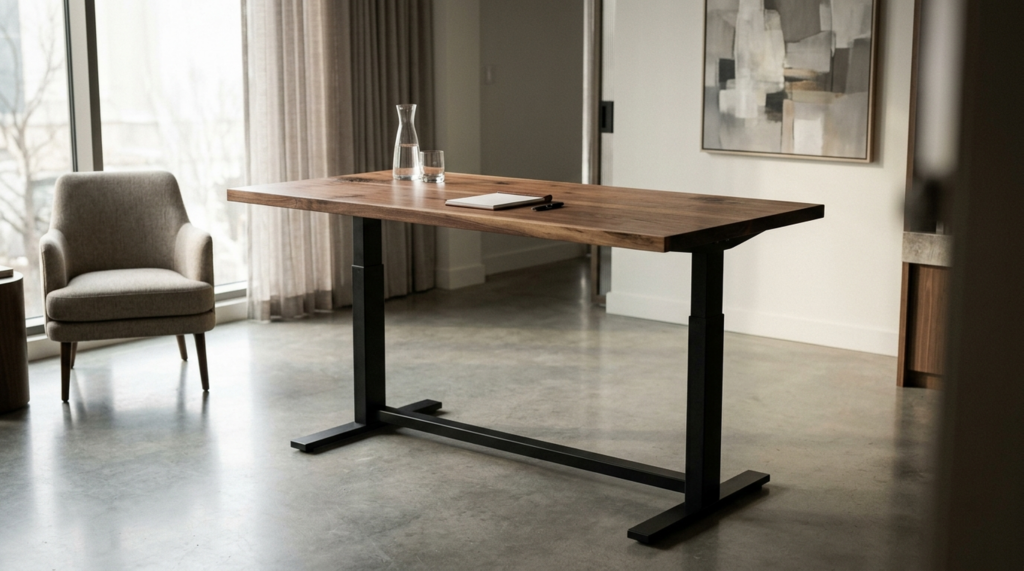
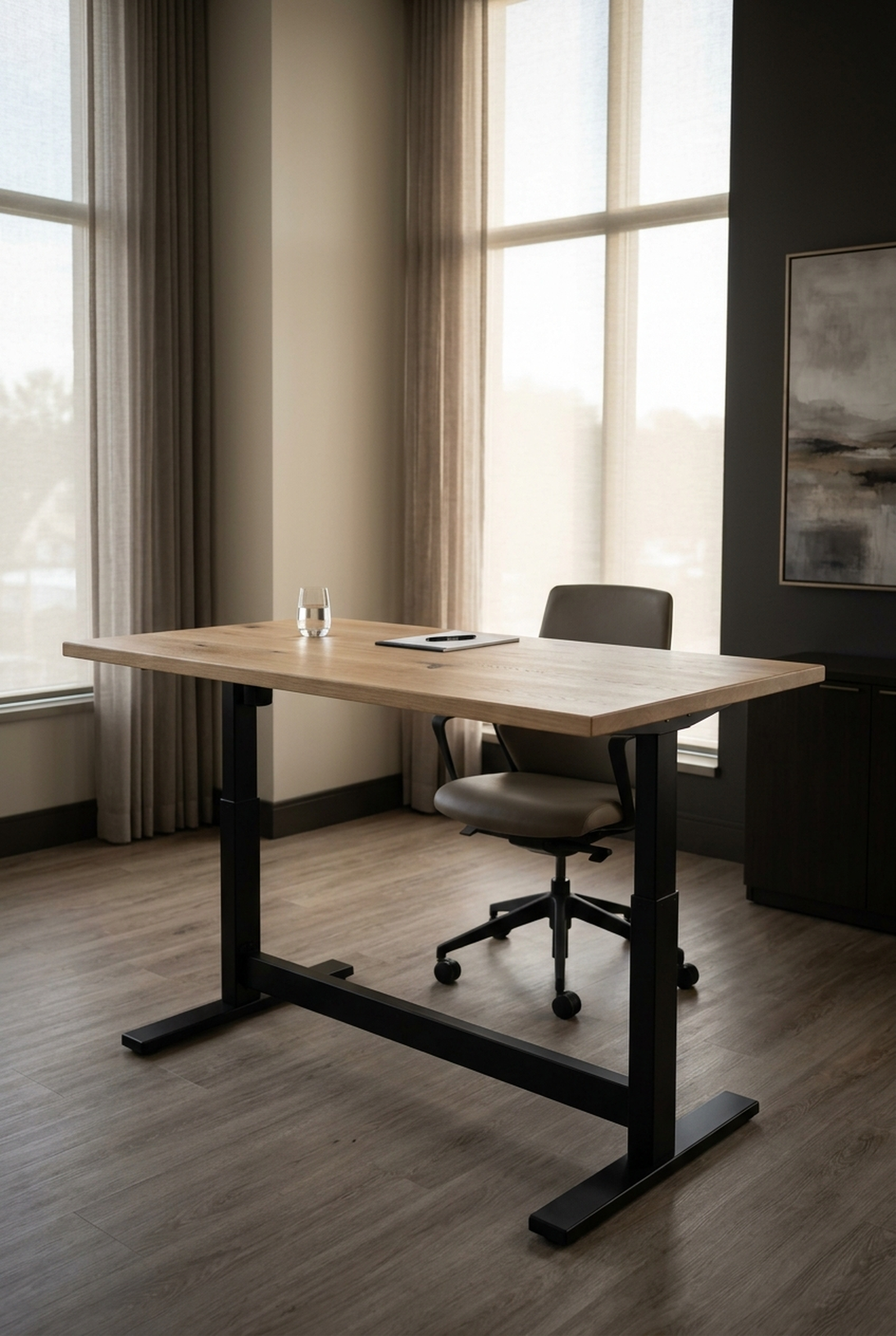
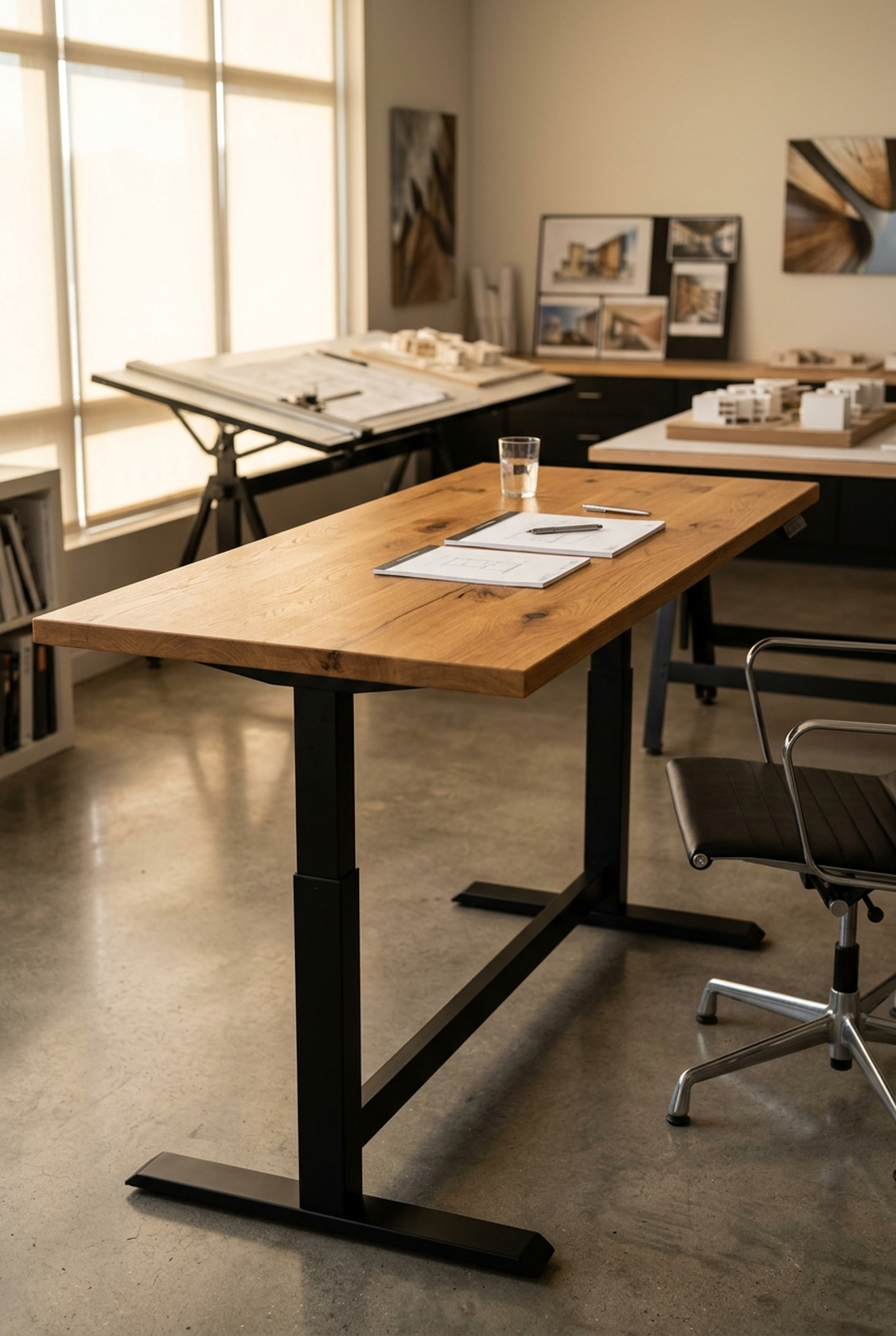
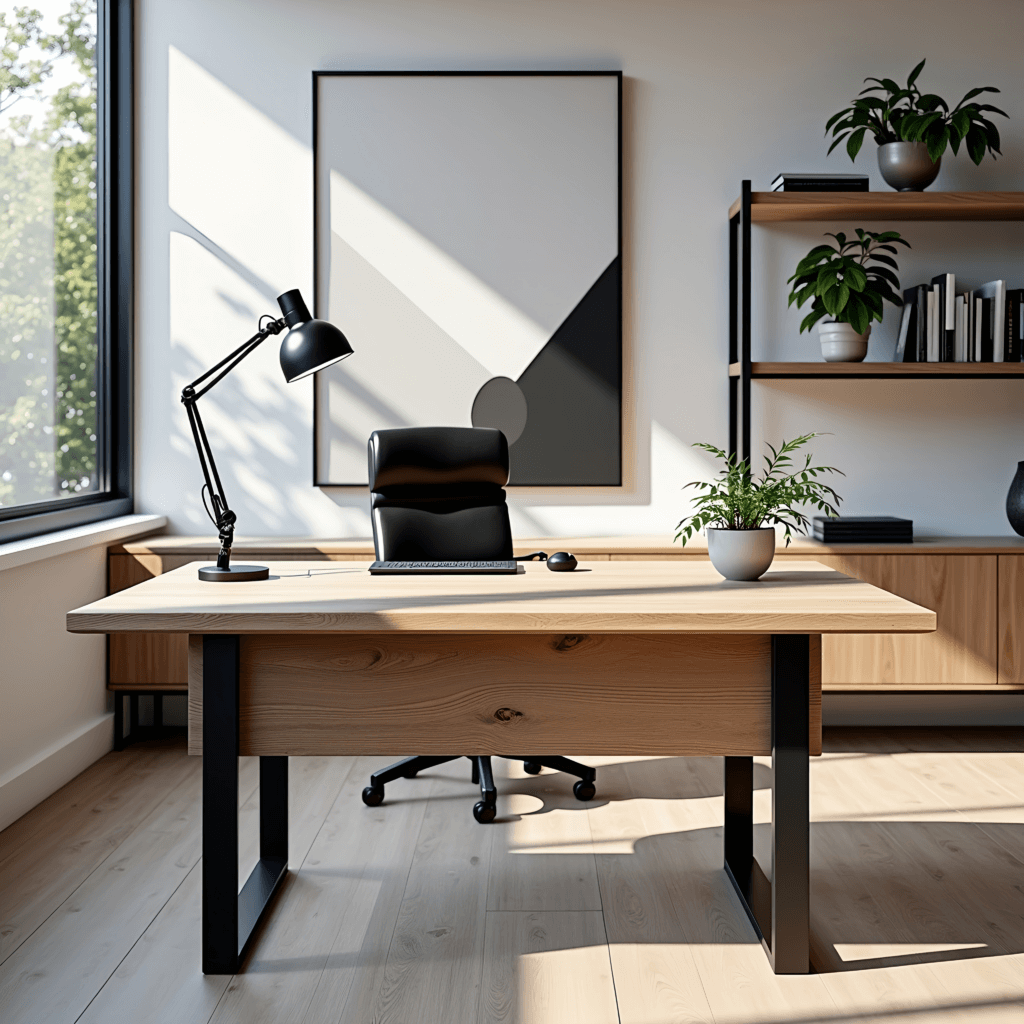
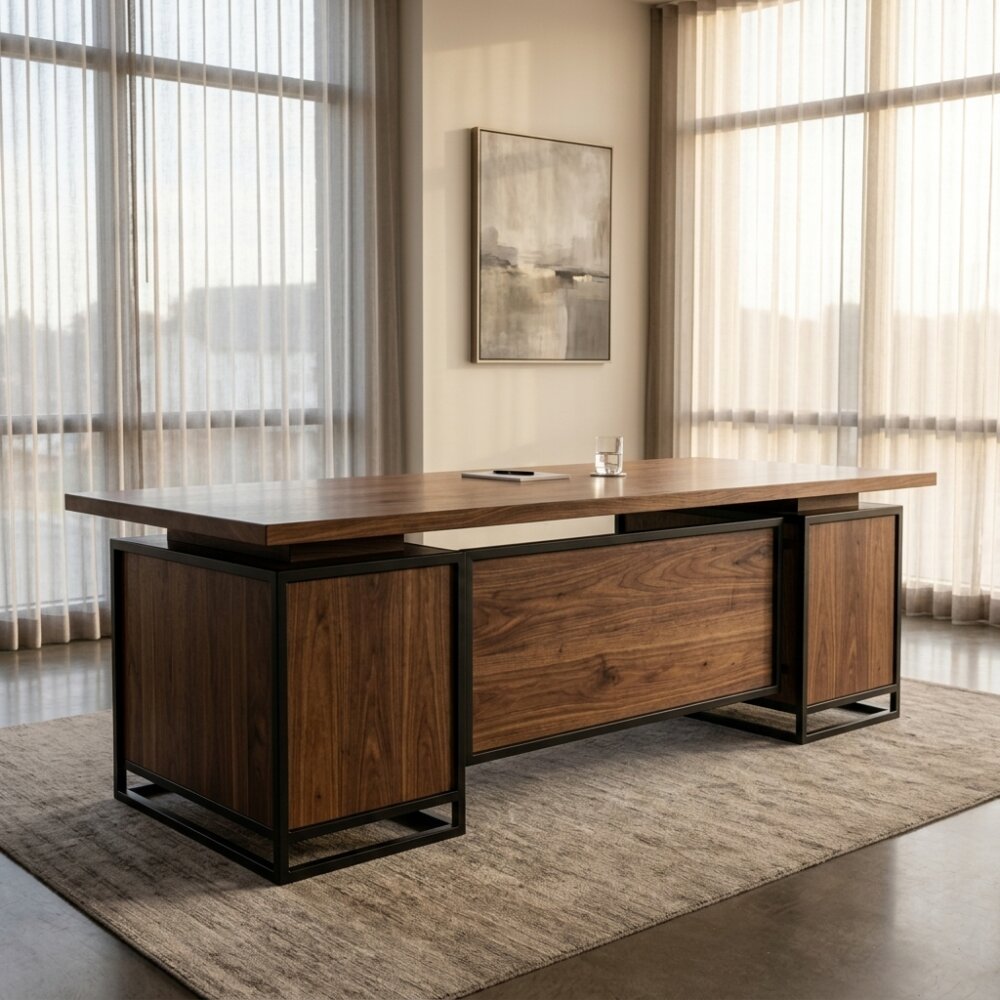
A standing executive desk pairs a solid hardwood top with a motorized steel base that raises and lowers, so you can work seated or standing and switch through the day. It is the executive version of the sit-stand desk: the same height flexibility, in a real wood piece that belongs in a leader’s office rather than a flat-pack laminate unit. This guide covers why people move to a sit-stand desk, the height range to look for, what to know about the base, and how a solid wood top changes the equation.
The case for sit-stand is simple: sitting all day is hard on the body, and standing all day is its own problem. A desk that moves lets you alternate, an hour seated, a stretch standing, which keeps energy up and takes pressure off the back and neck. For a leader who is at the desk for long stretches and on calls much of the day, the ability to stand without leaving the desk is the whole point.
Sit-stand height range
The desk should reach from a comfortable seated height to a comfortable standing height for the person using it.
Position
Typical height
For
Seated
~29–30 in
Standard seated work, forearms level
Standing
~38–46 in
Varies with the user’s height; elbows at ~90°
Range needed
a span that covers both
Confirm the base travels through your seated and standing heights
Set standing height so your elbows sit at about a right angle and the screen is near eye level. A taller user needs a base that travels higher; confirm the range covers both your seated and standing positions before ordering.
The base: what holds it up
A solid wood top on a motorized steel base — Fargo Woodworks
On a sit-stand desk, the base is the machine. A motorized steel base raises and lowers the top; the things that matter are how high and low it travels, how steady it is at full height, and how much weight it carries. A solid hardwood top is heavier than a laminate one, so the base has to be matched to it, which is exactly why a furniture-grade standing desk is built as a pair: a solid wood top on a base specced to lift it smoothly and hold steady when you lean in.
The trade vs. a flat-pack standing desk
A big-box sit-stand desk is cheap and looks it: a laminate slab on a wobbly frame. A solid hardwood standing desk costs more and reads as executive furniture, with a top that can be refinished and a base specced to carry the real weight of solid wood.
Sizing the top
Size the top like any executive desk: about 60 to 72 inches wide and 30 to 36 inches deep for a leader’s desk, narrower for a compact office. The depth holds your monitors and leaves room to write; the width sets the presence. Keep the footprint sized to the room, and remember a standing desk needs clear floor in front so you can step in close while standing.
Standing or seated, size the top like any executive desk — Fargo Woodworks
Solid wood and steel, built to order
Fargo Woodworks builds its standing desk by hand in Fargo, North Dakota: a solid American hardwood top, in walnut, white oak, red oak, or maple, on a hand-welded steel base. Built to order, the top is sized to your room and finished to match the rest of the office, so the standing desk reads as part of a cohesive office rather than a piece of gym equipment in the corner.
Fargo Woodworks executive desks
Every Fargo Woodworks desk is handcrafted to order in Fargo, North Dakota from solid American hardwood, and ships nationwide. A selection is below.
An executive desk with a motorized base that raises and lowers, so you can work seated or standing and switch through the day. Fargo Woodworks builds one with a solid hardwood top on a hand-welded steel base.
What height should a standing desk reach?
From a comfortable seated height (around 29–30 inches) up to a standing height where your elbows sit at about a right angle (often ~38–46 inches, depending on your height). Confirm the base travels through both your seated and standing positions.
Is a solid wood top too heavy for a sit-stand base?
No, when the desk is built as a pair. A solid hardwood top is heavier than laminate, so the base is specced to lift it smoothly and hold steady. That matching is the advantage of a furniture-grade standing desk over a flat-pack one.
How big should a standing executive desk be?
Size the top like any executive desk: about 60–72 inches wide and 30–36 inches deep for a leader’s office, narrower for a compact room. Leave clear floor in front so you can step in close while standing.
Is a standing desk worth it?
For anyone at the desk for long stretches, alternating between sitting and standing eases pressure on the back and neck and helps keep energy up. A solid wood version adds the durability and look of real furniture.
Does Fargo Woodworks make a custom standing desk?
Yes. The standing desk is built to order in Fargo, North Dakota with a solid American hardwood top on a hand-welded steel base, sized and finished to your office. Nationwide shipping; white-glove delivery available on request.