
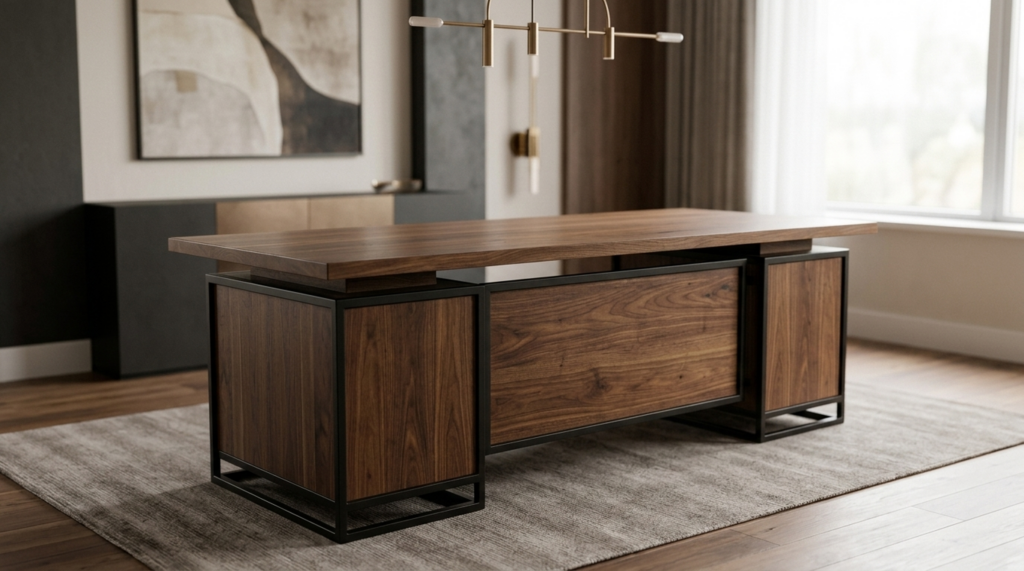
An executive desk is where the work of running a company gets done, and it is usually the piece a visitor remembers from the room. Choosing one well comes down to a few practical decisions, covered in order below: size, configuration, what the desk is made of, and whether a stock size fits or the office needs a custom build.
Fargo Woodworks builds desks by hand in Fargo, North Dakota, from solid American hardwood. The guidance here comes from building them, not only selling them.
Desk dimensions and sizing
Two things set the right desk size: the person who will use it, and the room it goes in.
A desk top needs enough room to work without crowding. Twenty-four inches of depth handles a laptop. Thirty inches or more is better once a monitor, a notepad, and room to write are all in play. Width depends on the role. A compact task desk runs 42 to 54 inches. A standard office desk is 54 to 66 inches. An executive desk is usually 66 inches or wider.
Behind the desk, leave 36 to 42 inches of clearance so the chair moves freely. Standard desk height is 29 to 30 inches, with about 24 inches of knee clearance underneath.
| Desk type | Typical width | Typical depth |
|---|---|---|
| Compact / task desk | 42–54 in | 24–30 in |
| Standard office desk | 54–66 in | 28–32 in |
| Executive desk | 66–84 in | 32–36 in |
| L-shaped / corner desk | 60–72 in per side | 24–30 in |
Fargo Woodworks builds desks in more than 15 size variations and will build to an exact dimension when a room calls for it.
Quick sizing rule
Plan on 30 or more inches of desk depth once a monitor is in play, and 36 to 42 inches of clearance behind the desk for the chair.
Desk configurations
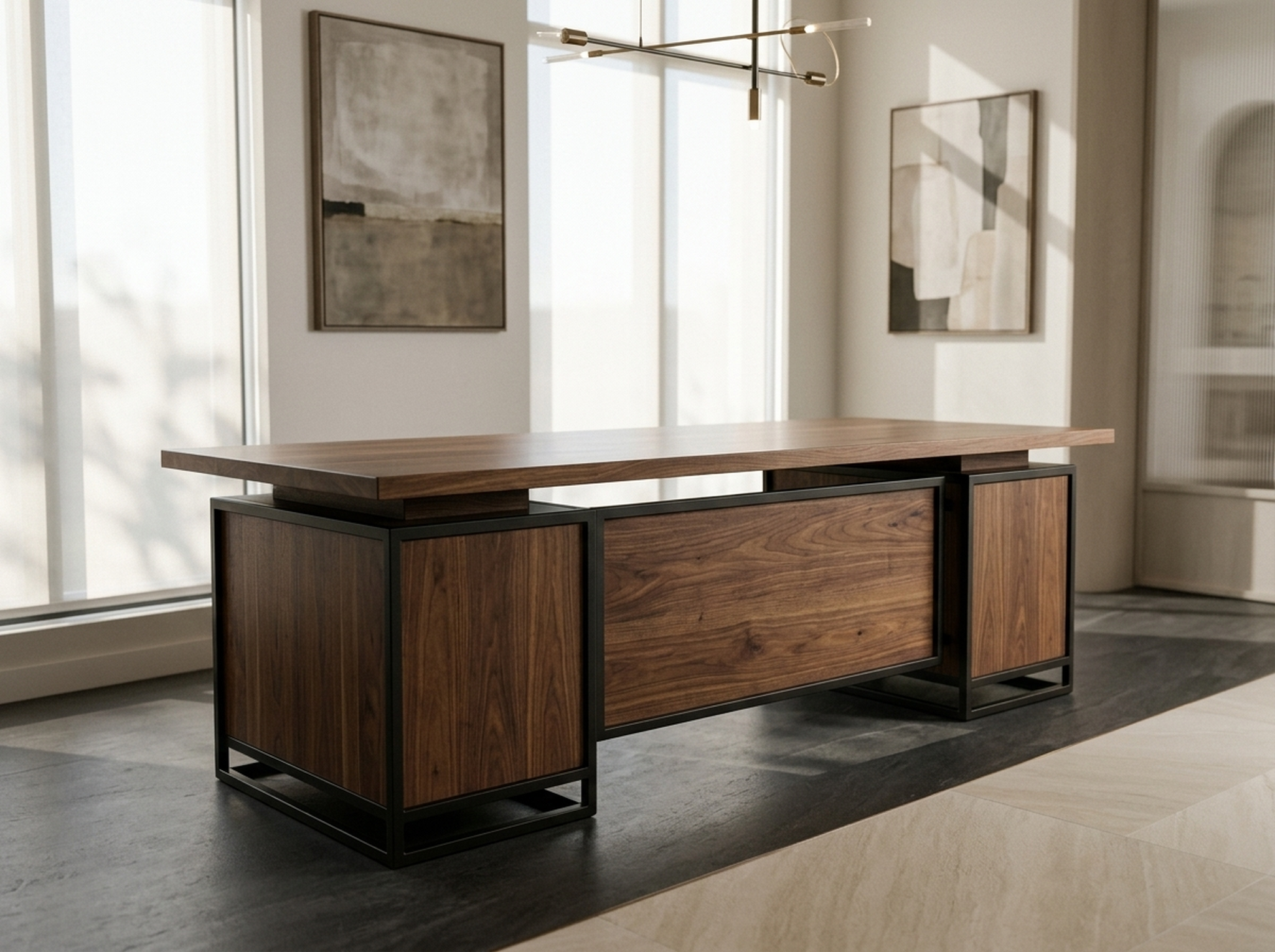
Most desks fall into three configurations. A single rectangular desk is the default and suits most offices. An L-shaped or corner desk adds a return for a second work surface or a place to lay out a project, and it uses a corner well. A standing desk raises and lowers so one desk works seated or standing. The right configuration depends on the room and how the day is spent.
What office desks are made of
Most desks sold for offices are particleboard or MDF under a veneer or laminate. They are inexpensive and they photograph well. Over years of daily use the edges chip, the surface scratches in a way that cannot be sanded out, and the desk starts to look its age.
A solid hardwood desk behaves differently. The top can be refinished years into its life, it takes the wear of daily work without showing it quickly, and it holds a presence a veneered top does not.
Fargo Woodworks builds every desk from solid American hardwood, with lumber sourced in the USA, in four species:
- Walnut. Rich and chocolate-brown, with dramatic grain. The classic executive choice.
- White Oak. The most versatile species. Tighter grain, warm, quietly elegant.
- Red Oak. Bold, open grain with warm undertones.
- Maple. Pale and creamy, with a fine, consistent grain.
Tops sit on hand-welded steel frames built in the same shop.
Solid wood vs. veneer
A veneered desk is cheaper up front and disposable. A solid hardwood desk can be refinished and kept for decades. For a desk used every day, that difference compounds.
Finishes
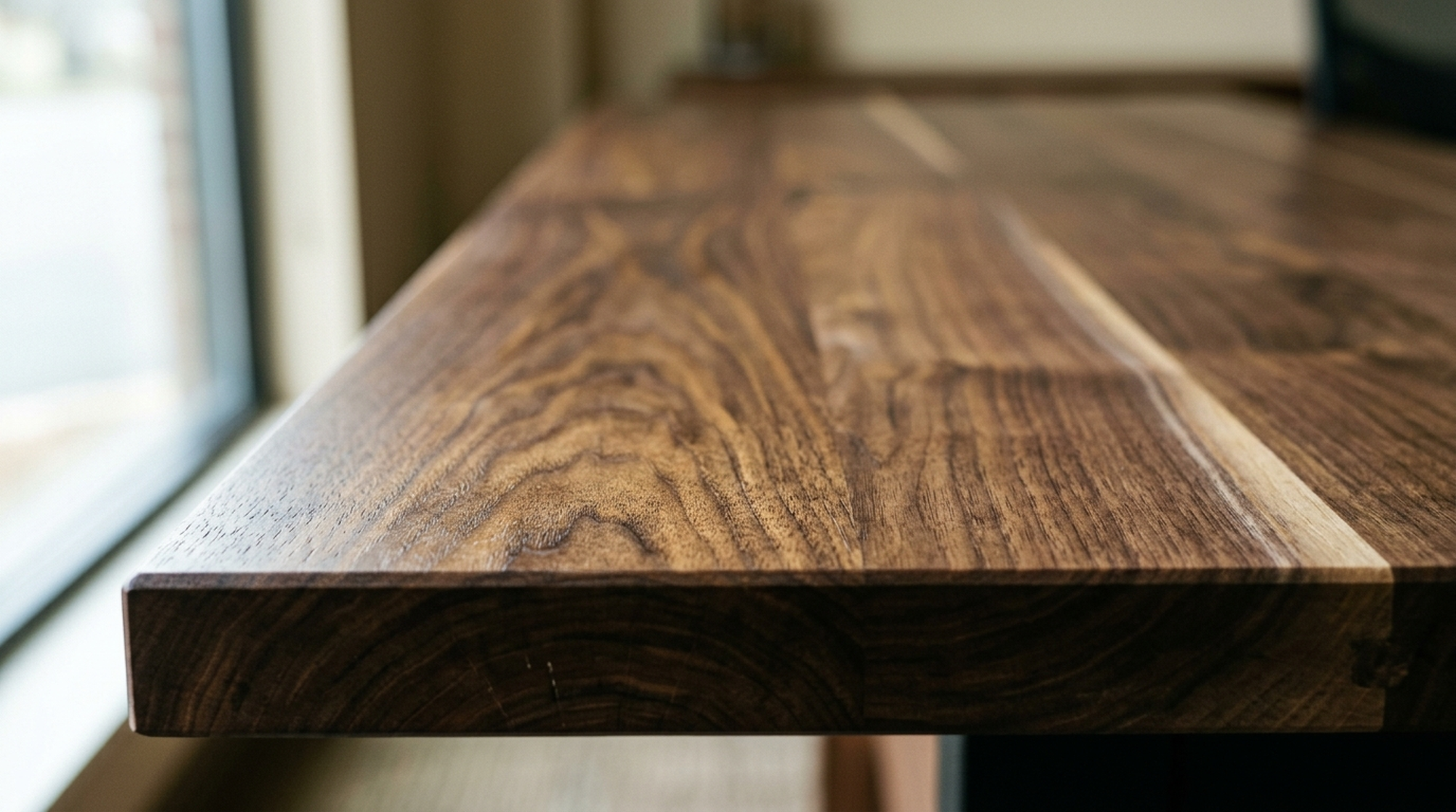
Fargo Woodworks finishes every desk with its Signature in-house finishes, a proprietary range developed and applied by hand in the Fargo workshop. Finishes are named by species and color: Walnut – Clear, Walnut – Black, White Oak – Natural, White Oak – Black, and similar combinations. Each is a matte, hand-applied finish that protects the surface and leaves the grain visible.
One practical point for buyers. A hand-applied finish on solid wood can be repaired in place. A factory laminate cannot.
Standing and sit-stand desks
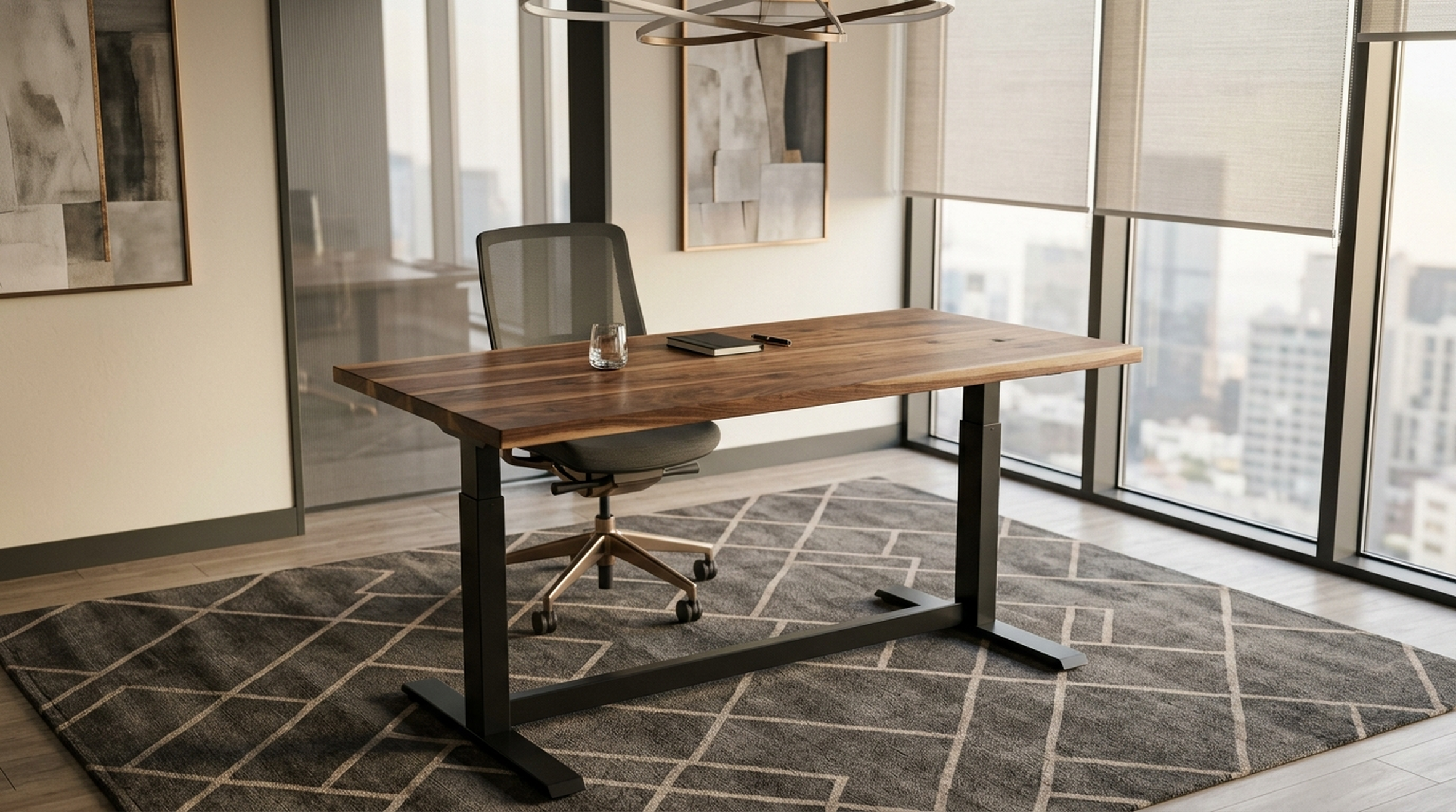
A standing desk earns its place for anyone who spends long stretches at a desk. The Fargo Woodworks standing desk pairs a solid hardwood top with a motorized, height-adjustable steel base. It moves through a 28-to-48-inch range and holds up to 300 pounds, so one desk works for sitting and standing without a separate piece of furniture.
The part to scrutinize on a standing desk is the top. Many sit-stand desks use a thin laminate top to keep the weight down. A solid hardwood top is heavier, and it is also the part of the desk that lasts.
Stock sizes or a custom desk?
Fargo Woodworks builds a range of named desk designs, from the clean Atlas, Horizon, and Lincoln to the L-shaped Broadway Corner Desk and the substantial Steele. Most come in 8 or more wood and finish options and 15 or more size variations, which covers most offices.
A custom desk makes sense when the room is an unusual size or shape, when the desk needs to match other pieces in the office, or when a live-edge top is the look. Because everything is built to order in one shop, a custom desk follows the same process as a stock size.
A note on a cohesive office
A desk rarely stands alone. Because every piece is handcrafted to order in the same shop, an executive desk can be built to match a reception desk, credenzas, shelving, and the conference table in the same wood and finish, so the whole office reads as one environment. For the boardroom side of that, see the Conference Tables buyer’s guide. Logo and branded detailing is available on select pieces.
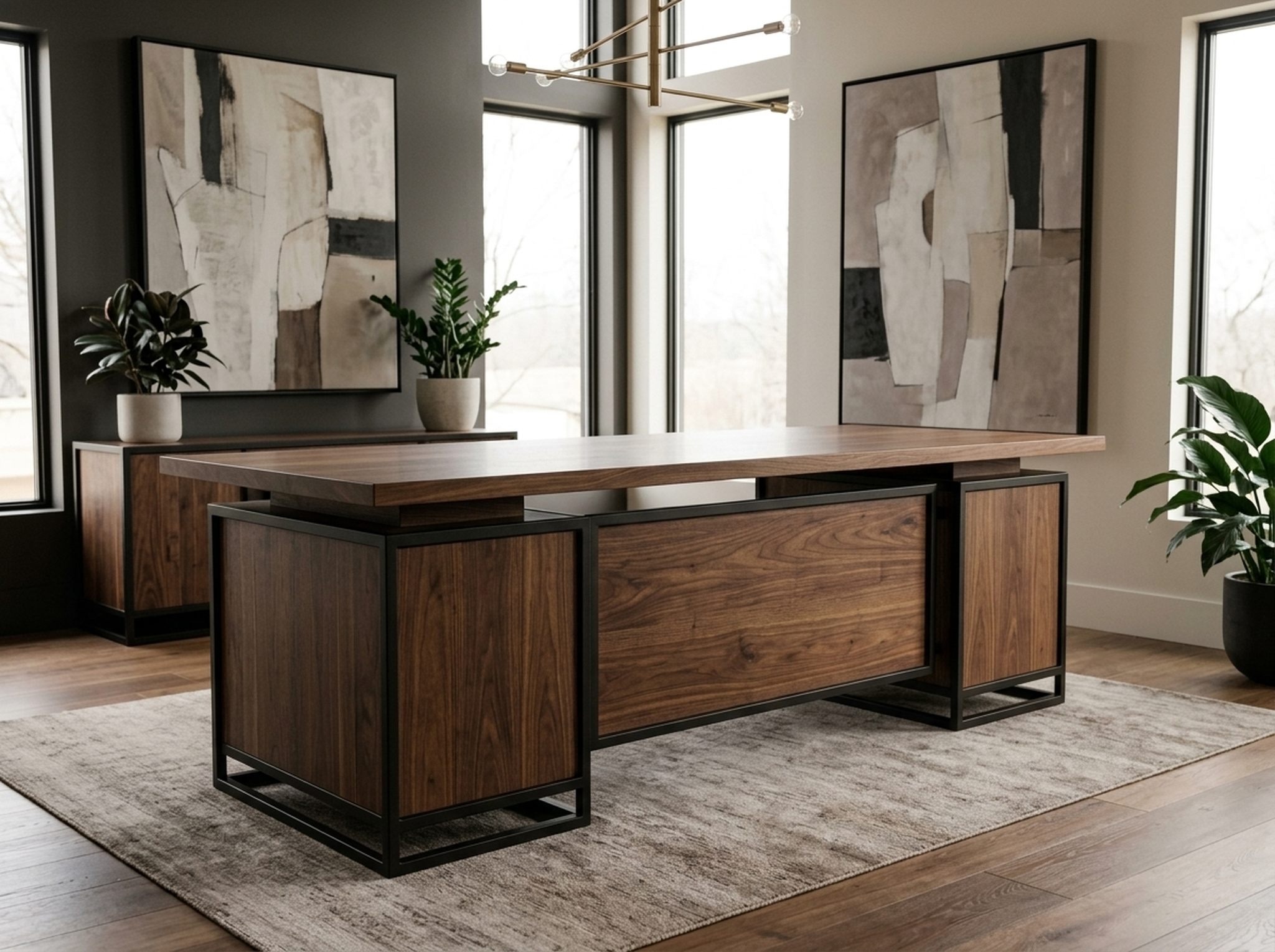
How much does an executive desk cost?
Price depends on size, wood species, and configuration. Fargo Woodworks’ handcrafted solid-hardwood desks generally run from around $1,250 for core designs like the Atlas and Sienna, to roughly $2,500 to $2,800 for larger executive desks and the motorized standing desk, up to $6,500 for the Hartford Executive Desk.
Prices are current as of publication and subject to change. See each product page for current pricing and available sizes.
Set against a veneered desk from an office-supply store at a fraction of the price, what that buys is a desk built to last decades and to be refinished rather than replaced.
Fargo Woodworks desks
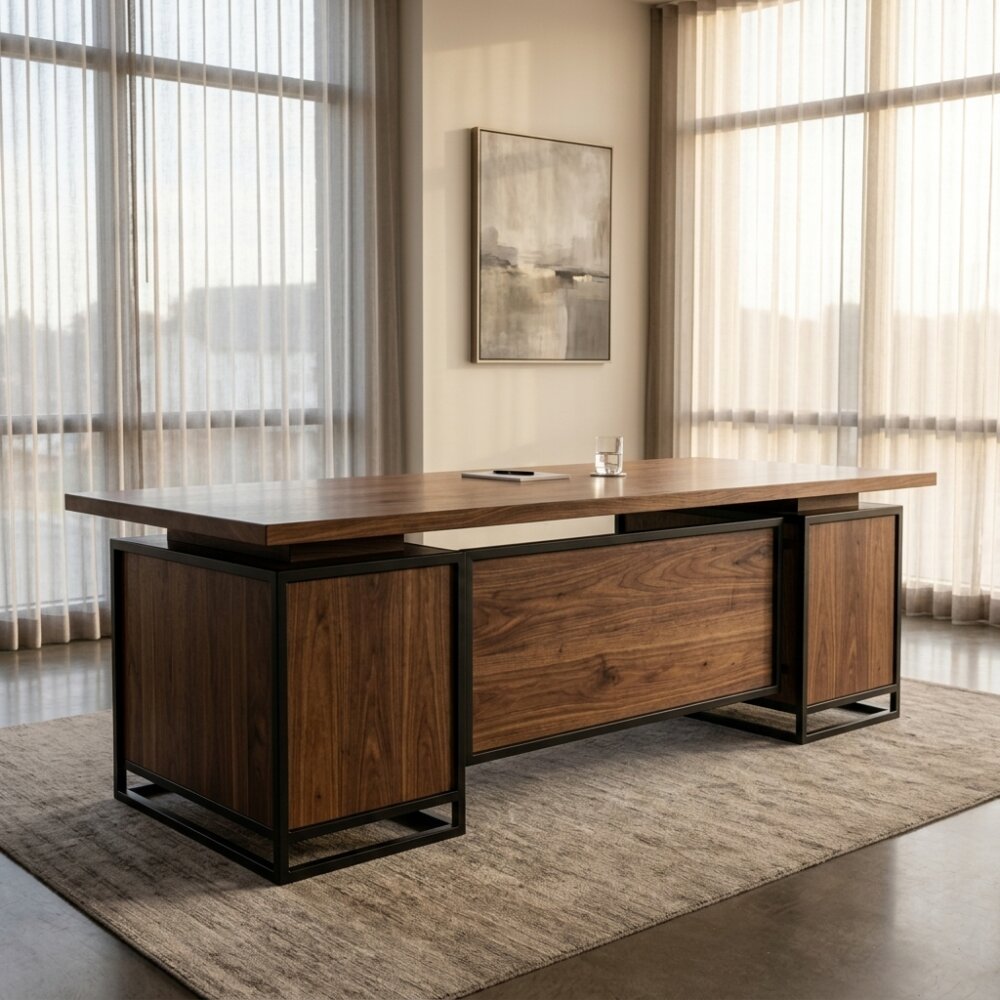
Every Fargo Woodworks desk is handcrafted to order in Fargo, North Dakota, from solid American hardwood, and ships nationwide. A selection of the collection:
-
The Hartford Executive Desk
From: $6,500.00 -
The Broadway Corner Desk
From: $2,000.00 -
The Horizon Desk
From: $1,500.00 -
The Atlas Desk
From: $1,500.00 -
Black Walnut Live Edge Executive Desk
From: $2,500.00 -
The Steele Desk
From: $2,500.00



Sizing one out? See our executive desk dimensions & size guide.
Need two work zones? See our L-shaped executive desk guide.
Want to sit and stand? See our standing executive desk guide.
Frequently asked questions
What size should an executive desk be?
Executive desks are usually 66 inches wide or more and 32 to 36 inches deep. Leave 36 to 42 inches of clearance behind the desk for the chair. Fargo Woodworks builds desks in more than 15 size variations and to exact custom dimensions.
What is the best wood for an office desk?
Solid hardwood rather than veneer over particleboard. Walnut, White Oak, Red Oak, and Maple are all good choices. Solid wood can be refinished and lasts decades. Walnut is the classic executive choice.
Is a standing desk worth it?
For anyone at a desk for long stretches, yes. The part that matters most is the top: a solid hardwood top lasts where a thin laminate top does not. The Fargo Woodworks standing desk moves through a 28-to-48-inch range and holds up to 300 pounds.
What is the standard height of a desk?
About 29 to 30 inches for a seated desk, with roughly 24 inches of knee clearance underneath. A standing desk should adjust well above that; the Fargo Woodworks standing desk reaches 48 inches.
How long does a desk take to build?
Fargo Woodworks desks are handcrafted to order. Current production time is shown on each product page, since it varies with shop workload.
Does Fargo Woodworks ship desks nationwide?
Yes. Every desk is built in Fargo, North Dakota and ships nationwide. White-glove delivery is available on request.
Design a desk for your office
Built to last. Designed with intent. — Fargo Woodworks, Fargo, North Dakota.
Trusted by Industry Leaders