
Shelving is where an office shows what it values. It holds the reference library, the awards, the samples a firm hands a client, and it does it in plain view. Most offices settle for melamine units that sag in a year. They don’t have to. This guide covers how to choose shelving for an office, in order: what it’s for, where it sits, how to size it, how to configure open and closed storage, what it’s made of, and what it costs.
Fargo Woodworks builds shelving by hand in Fargo, North Dakota, from solid American hardwood, often paired with hand-welded steel. The guidance here comes from building it, not only selling it.
What office shelving is for
Four jobs come up most, and the right one drives the design.
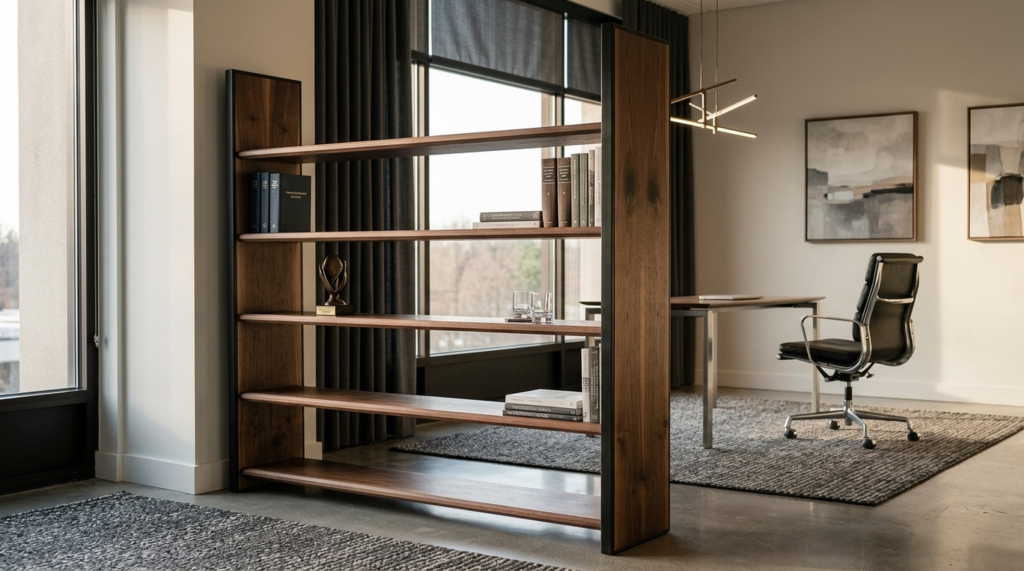
Open display puts books, awards, and product samples on view, and works in a reception area, a client-facing office, or a showroom. A reference wall holds binders, catalogs, and records where a team can reach them. Room division uses a freestanding open unit to separate a workspace without closing it off or blocking light. And a storage wall pairs open shelves above with closed cabinets below in one freestanding unit, common in an executive office or a conference room.
Decide which job leads before anything else. It sets the height, the depth, and the mix of open shelves and closed cabinets.
Start with the job
Display → open shelves at eye level. Reference → deeper shelves, more of them. Division → freestanding, open both sides. Storage wall → shelves over a closed base.
Against a wall or dividing a room?
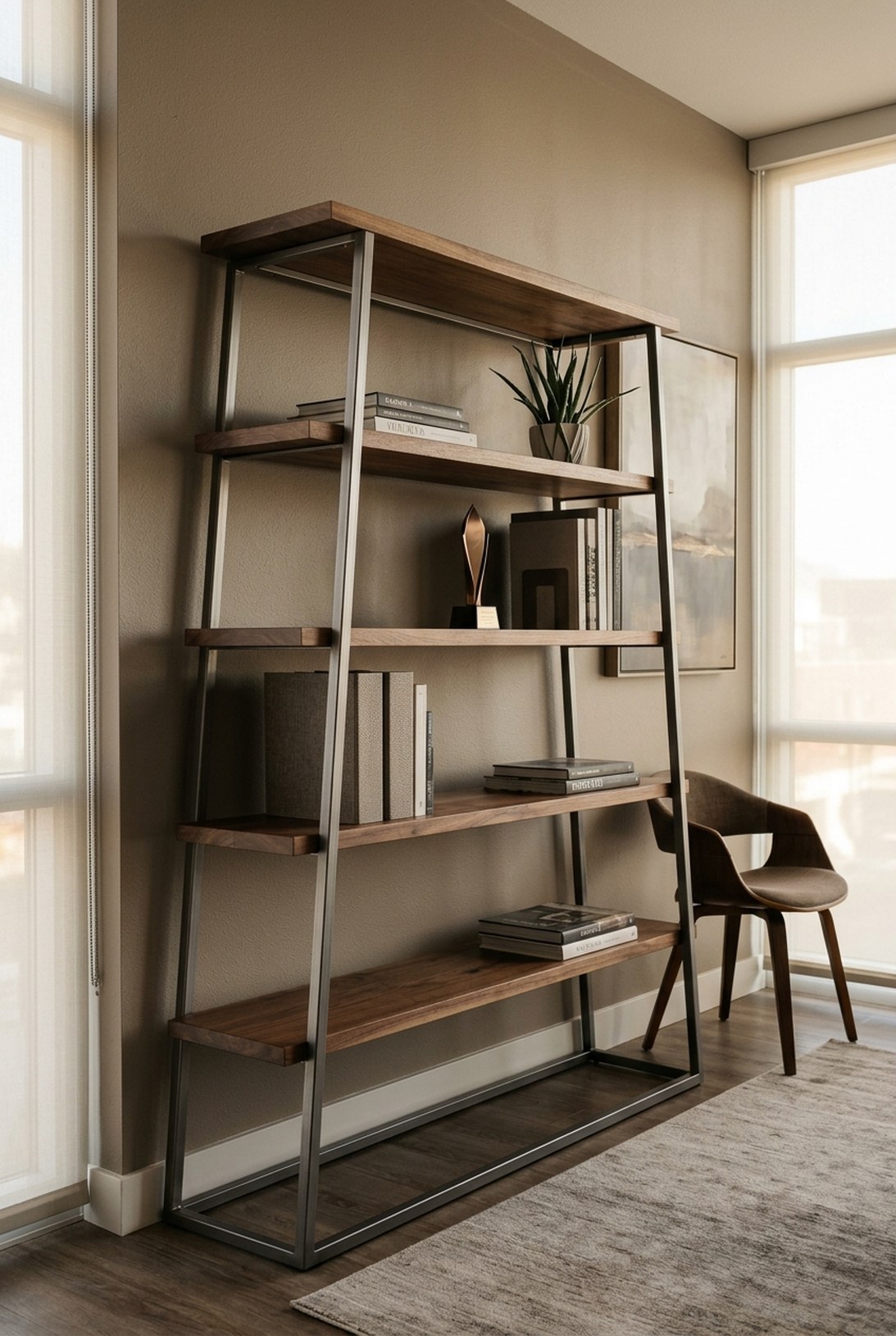
A freestanding unit is the common choice for an office. It stands against a wall, reads as furniture, and moves if the office changes. Solid hardwood uprights on a steel frame give it the rigidity to carry a real load without bowing.
An open unit also works in the middle of a room. Set as a divider, it separates a workspace from a walkway or a meeting area without closing either off or blocking the light. Because every piece is built to order, the height, width, and depth start from how you’ll use it and where it sits.
How to size office shelving
Three measurements decide it: height, depth, and shelf span.
For height, a freestanding unit usually runs 72 to 84 inches, tall enough to be useful without becoming a ladder job. Taller than that and a wall of storage usually reads better as two units side by side than one oversized piece. For depth, 11 to 12 inches suits books and binders, while 14 to 16 inches handles larger files, product samples, and display objects. For shelf span, solid hardwood holds a longer unsupported run than particleboard before it deflects, but as a rule keep individual shelf spans to about 36 inches for heavy books, or add a center support for longer runs.
Because every piece is built to order, these are starting points. Shelving can be built to the exact height of a wall, the width of an alcove, or the depth a specific collection needs.
| Use | Typical depth | Shelf span | Form |
|---|---|---|---|
| Books & binders | 11–12 in | ≤ 36 in | Freestanding |
| Files & samples | 14–16 in | ≤ 36 in | Freestanding |
| Display / reception | 12–14 in | flexible | Freestanding, open |
| Full storage wall | 12–16 in | with supports | Freestanding, mixed |
Open, closed, or mixed?
The mix of open shelves and closed cabinets should match what goes on the wall.
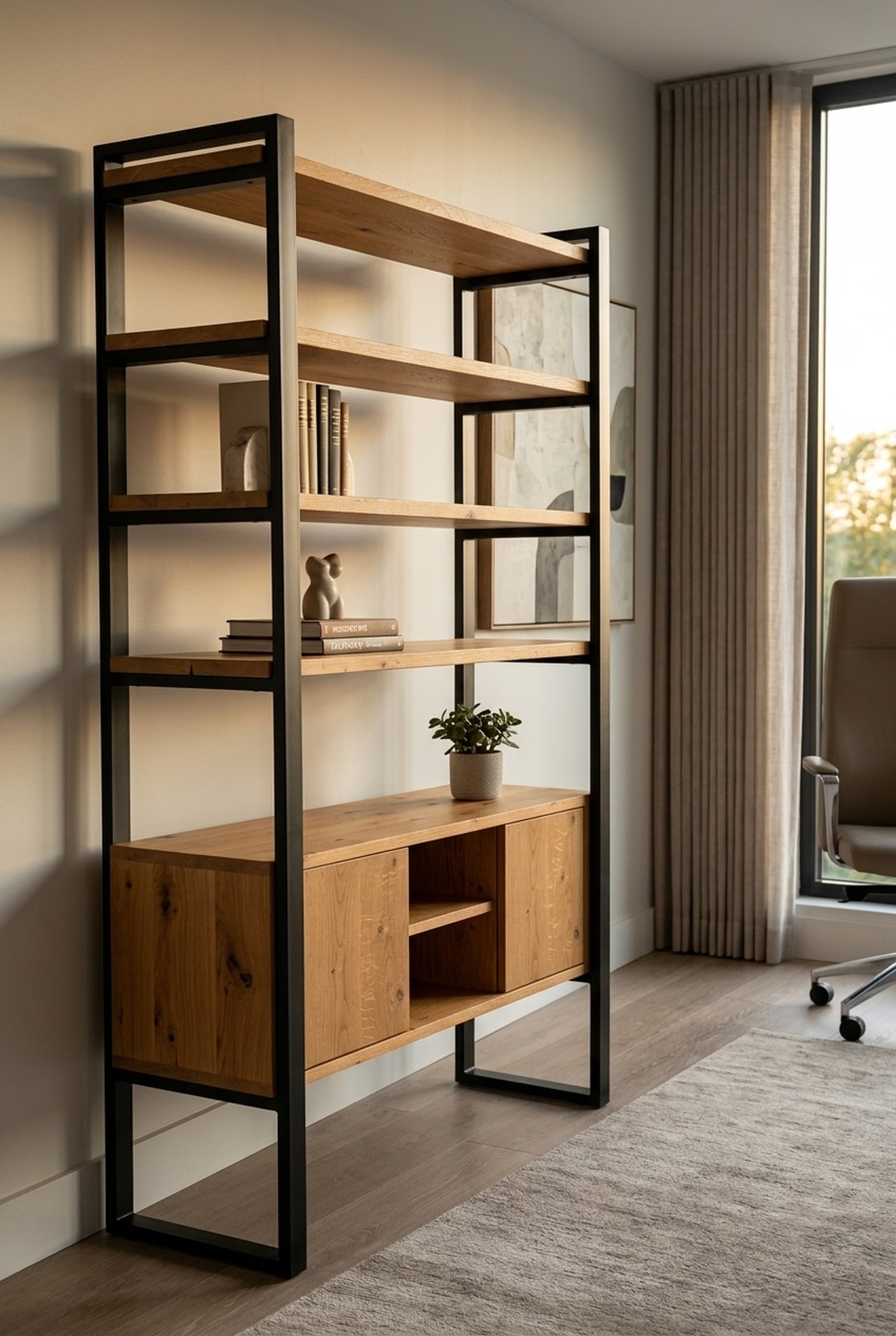
Open shelves display and keep things in reach, and suit books, awards, and samples. Closed cabinets at the base hide supplies, files, and anything you’d rather not see, and give the unit visual weight at the bottom where it belongs. A mixed unit, closed below and open above, is the most useful configuration for most offices: storage where you want it hidden, display where you want it seen. For a full wall, a shelving unit can sit next to a matching credenza to add a work surface and more closed storage.
Configuration quick rule
Open above for display and reach. Closed below for supplies and weight. Mixed is the office default. Pair with a credenza for a full wall.
What office shelving is made of
This is where quality is decided. Most office shelving is melamine or veneer over particleboard. It looks acceptable on day one and tells on itself fast: the shelves bow under books, the edges chip, and the unit can’t be repaired or refinished.
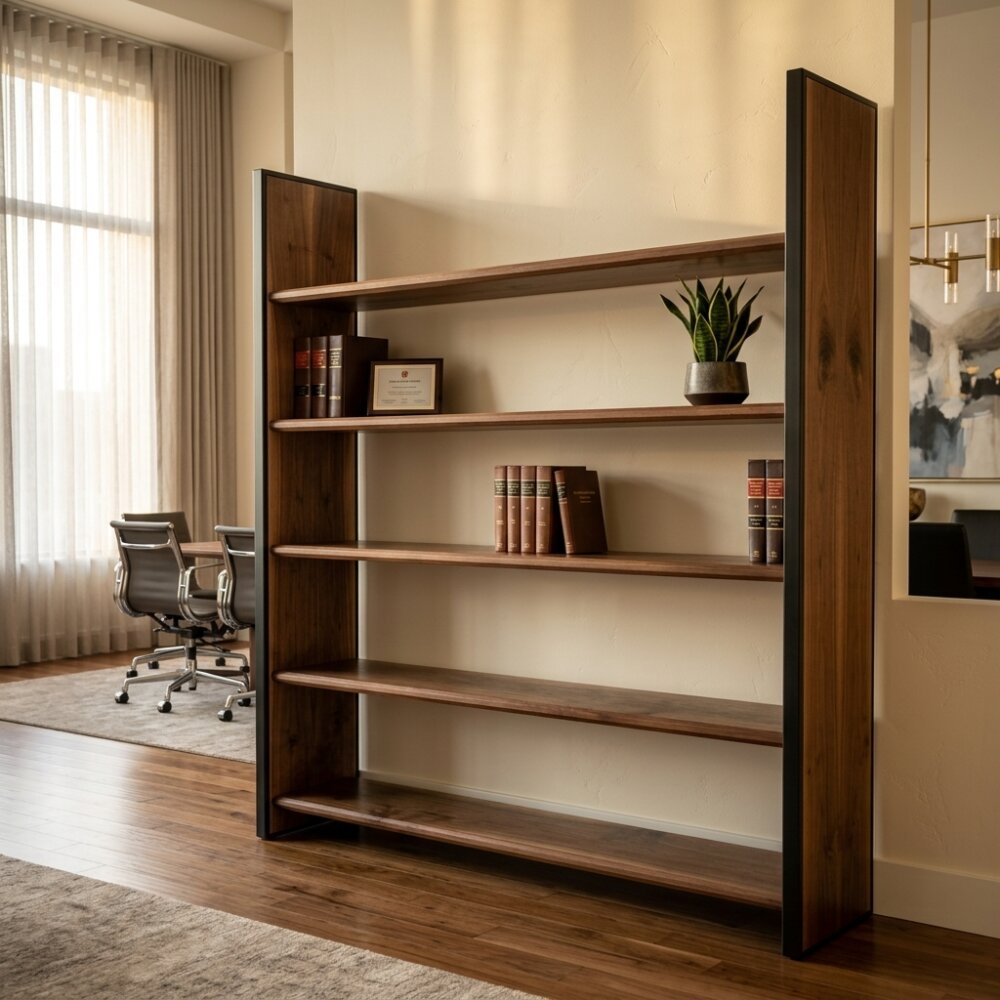
Solid hardwood behaves differently. It carries a real load with far less deflection, the edges take daily contact, and it can be sanded and refinished years on. Fargo Woodworks builds shelving from solid American hardwood, with lumber sourced in the USA, in four species:
- Walnut. Rich and chocolate-brown, with dramatic grain. The classic executive choice.
- White Oak. Tighter grain, warm and quietly elegant. The most versatile.
- Red Oak. Bold, open grain with warm undertones.
- Maple. Pale and creamy, with a fine, consistent grain.
Several lines pair the hardwood with hand-welded steel uprights or frames, built in the same shop, for an industrial-modern look that also adds rigidity.
Solid wood vs. melamine
A melamine shelf bows under a row of books and can’t be brought back. A solid hardwood shelf carries the load and can be refinished for decades. On a wall that holds weight every day, that difference is the whole point.
Finishes
Fargo Woodworks finishes every piece with its Signature in-house finishes, a proprietary range developed and applied by hand in the Fargo workshop. Finishes are named by species and color — Walnut – Clear, Walnut – Black, White Oak – Natural, White Oak – Black, and similar combinations. Each is a hand-applied finish that protects the surface and leaves the grain visible, and it can be repaired in place where a factory laminate cannot.
A note on a cohesive office
Shelving rarely stands alone. Because every piece is handcrafted to order in the same shop, a shelving wall can be built to match an executive desk, a conference table, a reception desk, and a credenza in the same wood and finish, so a whole office reads as one considered environment. See the Executive Desks, Conference Tables, and Sideboards & Credenzas buyer’s guides for those pieces.
How much does office shelving cost?
Price depends on size, wood species, and whether the unit is open, mixed, or a larger multi-section piece. Fargo Woodworks’ handcrafted solid-hardwood shelving starts around $1,250 for the Broadway shelf, with larger standard pieces such as the Hartford, Forge, Foundry, and Westbrook shelves starting around $2,500. Because every piece is built to order, the listed prices are starting points — taller runs, wider units, and custom configurations are quoted higher based on size and species. Larger and custom sizes are quoted from your measurements.
Prices are current as of publication and subject to change. See each product page for current pricing and available sizes.
Set against a melamine unit at a fraction of the price, what that buys is shelving that carries its load for decades and can be refinished rather than replaced.
Fargo Woodworks office shelving
Every Fargo Woodworks shelf is handcrafted to order in Fargo, North Dakota, from solid American hardwood, and ships nationwide. The current collection is below.
-
The Hartford Shelf
From: $2,500.00 -
The Broadway Shelf
From: $1,250.00 -
The Cascade Sideboard
From: $2,500.00 -
The Cassian Sideboard
From: $3,000.00 -
The Forge Shelf
From: $2,500.00 -
The Foundry Shelf
From: $2,500.00


Frequently asked questions
What is the best material for office shelving?
Solid hardwood rather than melamine or veneer over particleboard. Solid wood carries a real load with far less sagging, takes daily contact at the edges, and can be refinished. Walnut, White Oak, Red Oak, and Maple are all good choices; several Fargo Woodworks lines pair the wood with hand-welded steel for extra rigidity.
How deep should office shelving be?
About 11 to 12 inches for books and binders, and 14 to 16 inches for larger files, samples, or display objects. Because Fargo Woodworks builds to order, depth can be matched to what the shelving needs to hold.
How long can a shelf span without sagging?
Keep individual spans to about 36 inches for heavy books, or add a center support for longer runs. Solid hardwood holds a longer unsupported run than particleboard before it deflects.
Can office shelving double as a room divider?
Yes. A freestanding open unit works well in the middle of a room, separating a workspace from a walkway or meeting area while still letting light through. Because it stands on its own, it can be repositioned if the layout changes.
Can shelving be built to match the rest of an office?
Yes. Because every piece is handcrafted to order in the same shop, shelving can be built in the same wood and finish as a matching desk, conference table, reception desk, and credenza.
Does Fargo Woodworks ship office shelving nationwide?
Yes. Every piece is built in Fargo, North Dakota and ships nationwide. White-glove delivery is available on request.
Built to last. Designed with intent. — Fargo Woodworks, Fargo, North Dakota.
Trusted by Industry Leaders