
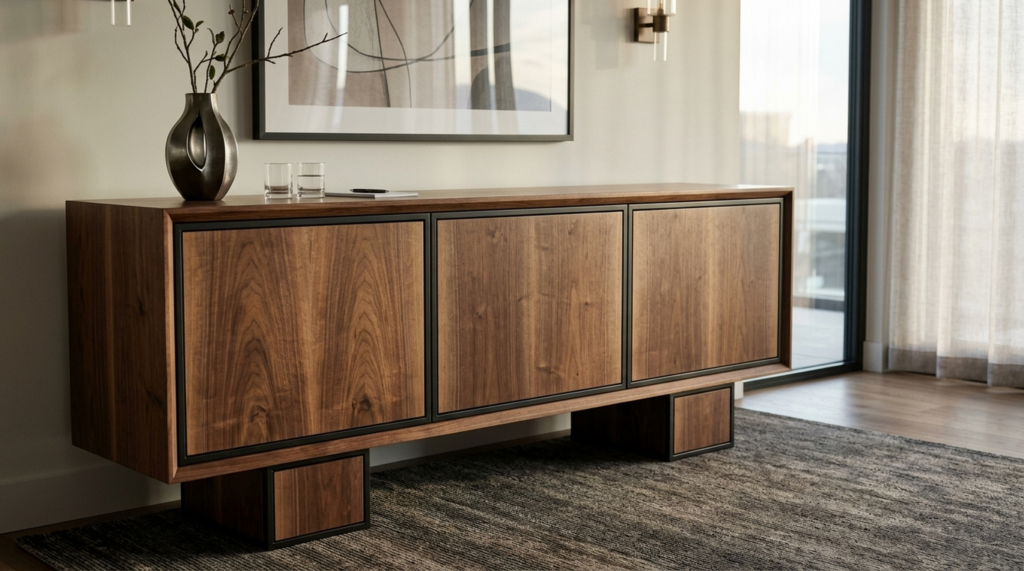
Storage is the part of an office people notice last and miss first. A credenza is where the printer hides, where the files live, where the coffee service sits during a long meeting. Chosen well, it does all of that and still reads as a piece of furniture rather than a filing cabinet. This guide covers how to choose one for an office, in the order the decisions actually come up: what it’s for, how to size it, how to configure the storage, what it’s made of, and what it costs.
Fargo Woodworks builds sideboards and credenzas by hand in Fargo, North Dakota, from solid American hardwood. The guidance here comes from building them, not only selling them.
Sideboard or credenza — what’s the difference?
In practice the two words point at the same piece of furniture: a long, low cabinet, usually 28 to 32 inches tall, built for storage along a wall. “Credenza” tends to get used in office settings, often for the cabinet that sits behind or beside a desk or along a conference room wall. “Sideboard” carries a dining-room history but describes the same form. Use whichever word your team already uses. What matters is the job it does and how it’s built.
What an office credenza is for
Three jobs come up most often, and the right one shapes everything else.
Behind the desk, a credenza gives an executive a second work surface and closed storage within arm’s reach, so the desk itself stays clear. In the conference room, it holds AV gear, supplies, and refreshments, and gives presenters a landing surface along the wall. In a reception or open area, it works as a room divider and display surface that hides clutter while keeping the space warm.
Decide which of these the piece is mainly for before anything else. It tells you the height, the depth, and the mix of doors, drawers, and open shelves.
Start with the job
Behind a desk → closed storage at desk height. Conference room → AV and supply storage with a clear top. Reception → display and division. The job sets the size and the storage mix.
How to size an office credenza
Two measurements decide the size: the wall and the use.
For length, a credenza behind a desk usually runs close to the width of the desk, commonly 60 to 72 inches. Along a conference room wall, length follows the room — 72 inches is common, and larger boardrooms carry 84 to 96 inches comfortably. Leave a few inches of clear wall at each end so the piece reads as intentional rather than wedged in.
For height, 28 to 30 inches lets a credenza tuck under a window sill and sit close to desk height for a return. Depth is usually 18 to 20 inches, enough for letter and legal files and most AV gear without crowding the walkway. Leave at least 36 inches of clearance in front for drawers and doors to open and for people to pass.
Because every piece is built to order, these are starting points, not fixed sizes. A credenza can be built to the exact length of a wall or to match the height of an existing desk.
| Setting | Typical length | Typical height | Typical depth |
|---|---|---|---|
| Behind a desk (return) | 60–72 in | 29–30 in | 18–20 in |
| Conference room wall | 72–96 in | 30–32 in | 18–20 in |
| Reception / open area | 60–84 in | 30–34 in | 18–22 in |
Configuring the storage
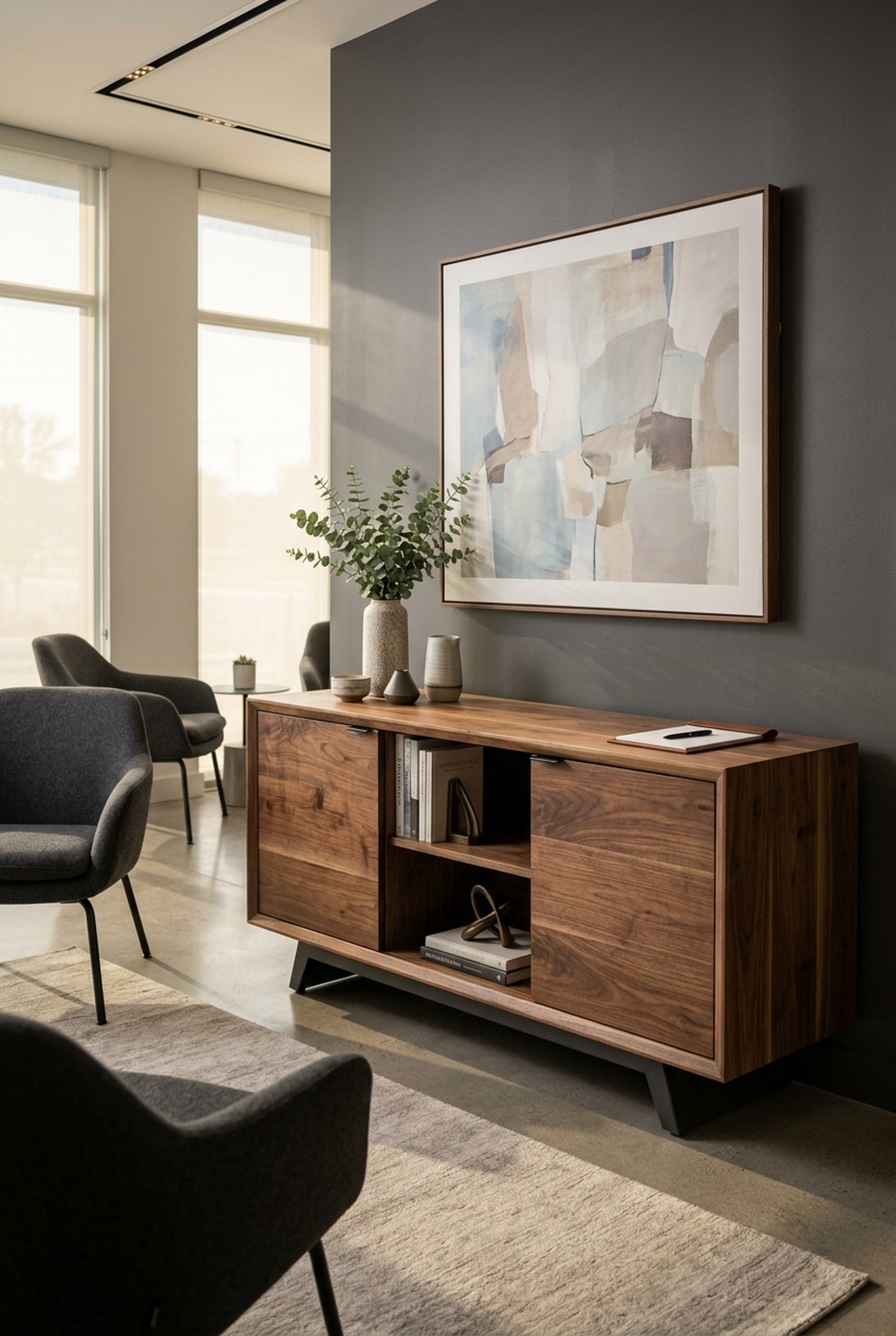
This is where a credenza earns its place. The mix of doors, drawers, and open shelves should match what actually goes inside.
Doors hide the most and keep a clean face — best for AV gear, supplies, and anything you’d rather not see. File drawers take letter or legal hanging folders and belong behind the desk or in a records area. Standard drawers hold the small things that otherwise sprawl across a desk. Open shelves or cubbies suit a reception or display setting, and a center open bay leaves room for a printer or a coffee service with the doors flanking it. Most office credenzas combine two or three of these. A common executive configuration is file drawers on one end, a door cabinet on the other, and a shallow drawer across the top.
Cable management matters here too. A credenza that holds AV gear or a printer should be built with a cord pass-through in the back panel so equipment can be plugged in without a gap behind the piece. It’s easier to build in than to retrofit.
Configuration quick rule
Doors hide gear. File drawers take hanging folders. Open bays fit a printer or coffee service. Build a cord pass-through if anything inside needs power.
What office credenzas are made of
This is where quality is decided. A lot of office storage is veneer or laminate over particleboard. It photographs well and costs little, and it shows its age quickly — the edges chip, the doors sag on their hinges, and the surface can’t be brought back.
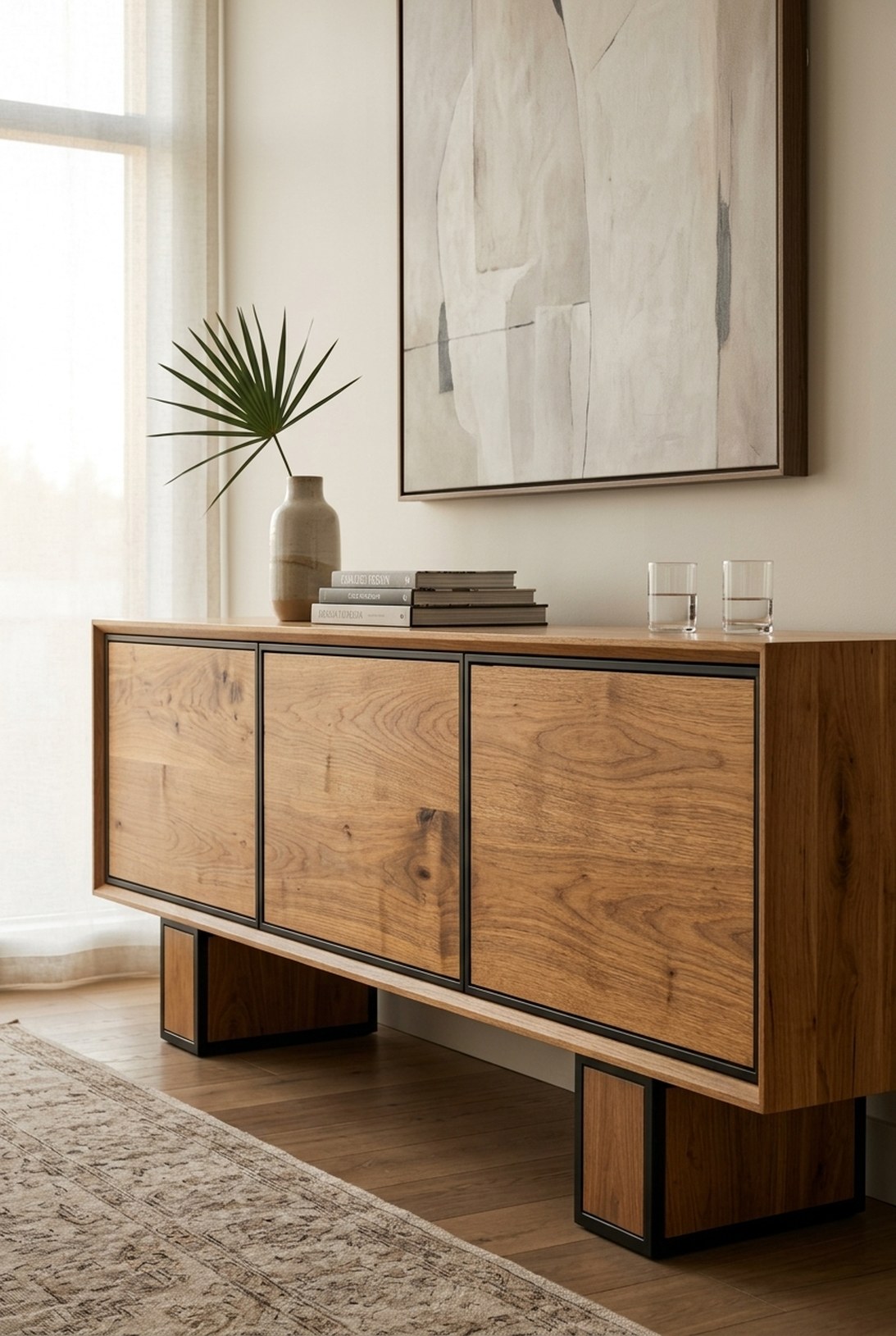
Solid hardwood is a different proposition. A solid top can be sanded and refinished years into its life, the case holds its shape, and the doors and drawers keep their fit. Fargo Woodworks builds every sideboard and credenza from solid American hardwood, with lumber sourced in the USA, in four species:
- Walnut. Rich and chocolate-brown, with dramatic grain. The classic executive choice.
- White Oak. Tighter grain, warm and quietly elegant. The most versatile.
- Red Oak. Bold, open grain with warm undertones.
- Maple. Pale and creamy, with a fine, consistent grain.
Cases are built with solid joinery and, on several lines, paired with hand-welded steel bases built in the same shop.
Solid wood vs. laminate
A laminate credenza is cheaper up front and disposable. A solid hardwood credenza can be refinished and kept for decades. For a piece that opens and closes every day, that difference compounds.
Finishes
Fargo Woodworks finishes every piece with its Signature in-house finishes, a proprietary range developed and applied by hand in the Fargo workshop. Finishes are named by species and color — Walnut – Clear, Walnut – Black, White Oak – Natural, White Oak – Black, and similar combinations. Each is a hand-applied finish that protects the surface and leaves the grain visible.
A practical point for buyers: a hand-applied finish on solid wood can be repaired in place. A factory laminate cannot. On a credenza that takes daily wear at door and drawer edges, that matters.
Freestanding or built-in?
A freestanding credenza is the common choice. It sits against a wall, moves if the office changes, and reads as furniture. A built-in makes sense when a credenza needs to run wall-to-wall, wrap a corner, or integrate with shelving above it for a single composed wall. Because everything is built to order, a built-in follows the same process as a freestanding piece; it just starts from the room’s dimensions and architecture.
A note on a cohesive office
A credenza rarely stands alone. Because every piece is handcrafted to order in the same shop, a credenza can be built to match an executive desk, a conference table, reception desk, and shelving in the same wood and finish, so a whole office reads as one considered environment instead of a set of separate purchases. See the Executive Desks buyer’s guide and the Conference Tables buyer’s guide for those pieces. Logo and branded detailing is also available on select pieces.
How much does an office credenza cost?
Price depends on size, wood species, and storage configuration. Fargo Woodworks’ handcrafted solid-hardwood sideboards and credenzas generally run from around $2,500 for core designs like the Cascade and Timberline, to about $3,000 for the Cassian, and up to $4,500 and beyond for larger pieces like the Hartford and fully custom commissions.
Prices are current as of publication and subject to change. See each product page for current pricing and available sizes.
Set against a laminate office credenza at a fraction of the price, what that buys is a piece built to last decades and to be refinished rather than replaced.
Fargo Woodworks sideboards & credenzas
Every Fargo Woodworks credenza is handcrafted to order in Fargo, North Dakota, from solid American hardwood, and ships nationwide. The current collection is below.
-
The Hartford Sideboard
From: $4,500.00 -
The Cascade Sideboard
From: $2,500.00 -
The Cassian Sideboard
From: $3,000.00 -
The Timberline Sideboard
From: $2,500.00
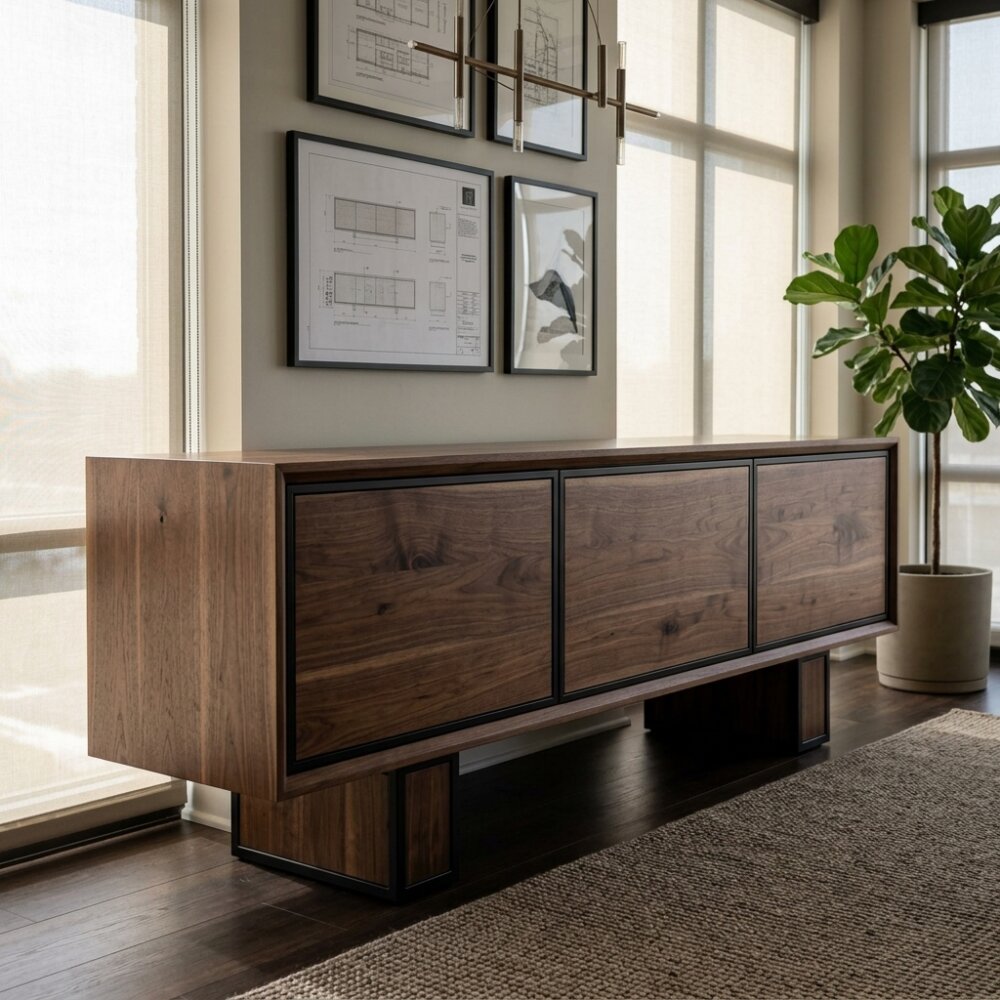


View all sideboards & credenzas →
Not sure what to call it? See credenza vs. sideboard vs. buffet.
Outfitting a meeting room? See how to choose a conference room credenza.
Need filing? See choosing a credenza with file storage.
Frequently asked questions
What is the difference between a sideboard and a credenza?
In practice they describe the same piece — a long, low storage cabinet for along a wall. “Credenza” is used more in office settings, often for the cabinet behind a desk or along a conference room wall. “Sideboard” has a dining-room history but describes the same form.
How tall is an office credenza?
Most are 28 to 32 inches tall, which tucks under a window sill and sits close to desk height for a return. Because Fargo Woodworks builds to order, the height can be matched to an existing desk.
What storage configuration should an office credenza have?
Match it to what goes inside. Doors hide AV gear and supplies, file drawers take hanging folders, and open bays fit a printer or coffee service. Most office credenzas combine two or three of these.
Can a credenza include cable management?
Yes. A credenza that holds AV gear or a printer should be built with a cord pass-through in the back panel. It is planned before the piece is built rather than retrofitted.
What wood is best for an office credenza?
Solid hardwood rather than veneer or laminate over particleboard. Walnut, White Oak, Red Oak, and Maple are all good choices. Solid wood can be refinished and lasts decades; walnut is the classic executive look and white oak the most versatile.
Does Fargo Woodworks ship credenzas nationwide?
Yes. Every piece is built in Fargo, North Dakota and ships nationwide. White-glove delivery is available on request.
Built to last. Designed with intent. — Fargo Woodworks, Fargo, North Dakota.
Trusted by Industry Leaders